
Agrigento is a historic Sicilian city set on a hill overlooking the sea, where the landscape shifts from the elevated urban centre to a nearby coast of bays, promontories, sandy shores and white cliffs. Its old town occupies the western summit of the hill, with narrow lanes and courtyards that preserve the imprint of Arab urban planning.
The city’s identity reaches back to ancient Akragas, founded in the 6th century BC by colonists from Gela and later remembered as one of the important centres of the Greek world in Sicily. Over time it passed through Roman, Arab, Norman and medieval phases, reflected in names such as Agrigentum, Kerkent and Girgenti before the modern name Agrigento restored the link with its Greco-Roman past.
Today, Agrigento feels layered rather than static: a city of evening strolls, steep streets and cultural memory, also tied to the writer Luigi Pirandello. Its distinctiveness lies in this close meeting of Greek origins, Arab-shaped urban fabric and a sea-facing Sicilian setting.
Patron Saint:
St. Gerland (Gerlando) – 25 February
Nearest Airport:
Comiso (Pio La Torre) – (117 km, 01:51)
Neighboring Cities:
Aragona, Cattolica Eraclea, Favara, Joppolo Giancaxio, Montallegro, Naro, Palma di Montechiaro, Porto Empedocle, Raffadali, Realmonte, Sant’Angelo Muxaro, Siculiana
Attractions in Agrigento
UNESCO Sites
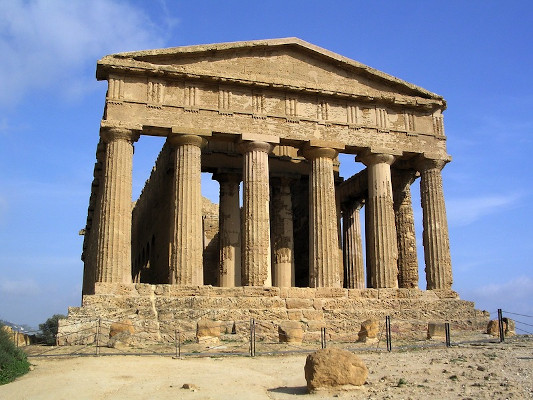
Valle dei Templi: The archaeological remains of ancient Akragas lie just outside the built-up town and have held UNESCO World Heritage status since 1997. The complex includes the temples of Concordia, Giunone Lacinia, Ercole, Giove Olimpico and the Dioscuri, alongside necropolises, sanctuaries and the Tomba di Terone.
Art and Architecture
Cattedrale di San Gerlando: Founded in the 11th century, Agrigento’s cathedral combines Norman and Gothic architectural features. A broad flight of steps leads up to the building, which stands beside a substantial bell tower.
Chiesa di Santa Maria dei Greci: Built over the remains of a Greek temple, this church stands in one of the oldest quarters of medieval Agrigento. Its entrance is marked by a pointed Arab-Norman portal.
Chiesa di San Lorenzo: Also called the Chiesa del Purgatorio, this church stands along Via Atenea. Its façade combines Renaissance and Baroque elements.
Chiesa di San Domenico: Overlooking Piazza Pirandello, San Domenico has a façade with Renaissance and Baroque features. It adjoins the former Dominican convent complex, which houses Agrigento’s town hall and Teatro Pirandello.
Chiesa di San Francesco di Paola: This church in the Rabato quarter contains frescoes by Domenico Provenzano and a Madonna della Catena attributed to the Gagini school.
Chiesa dell’Addolorata: Also in the Rabato quarter, this church is the Santuario di Maria Santissima dei Sette Dolori. Its Baroque interior is decorated with stuccowork in the Serpotta tradition.
Abbazia di Santo Spirito: Known locally as the Badia Grande, this Cistercian abbey is distinguished by its medieval architecture.
Chiesa di San Pietro: The church contains frescoes by Cristadoro, a distinctive feature of its interior decoration.
Beaches
Lido San Leone: San Leone is one of Agrigento’s principal beach areas, with sandy shores along the city’s coast.
Punta Bianca: Punta Bianca is another beach destination on Agrigento’s coastline, where beaches alternate with bays and headlands.
Things to Do in Agrigento
Traditional Events
Festa di San Gerlando: Traditionally held in the final days of February, the celebration includes a procession with the saint’s reliquary bust and an offering of oil for the votive lamp.
Festa di San Giuseppe: The March celebration includes a procession with the statue of San Giuseppe through the city. At the parish dedicated to the saint, the Tavolata di San Giuseppe brings together the blessing and sharing of food.
Mandorlo in Fiore: Agrigento’s annual almond-blossom festival takes place in March and celebrates the arrival of spring.
Settimana Santa: Holy Week traditions include Palm Sunday services and visits to the sepolcri, the decorated church altars of repose. On Good Friday, a procession carries the figure of Christ in an urn alongside the Madonna Addolorata.
Festa di San Calogero: This eight-day celebration traditionally runs from the first to the second Sunday in July. It is accompanied by the Sagra del Grano, a festival associated with wheat.
Presepe vivente di Montaperto: A living Nativity scene forms part of the Christmas traditions in Montaperto.
Museums
Museo Archeologico: Beside the former Cistercian complex of San Nicola, the archaeological museum displays finds from ancient Akragas and its surrounding territory.
Casa natale di Luigi Pirandello: Pirandello’s birthplace in contrada Caos presents documents, manuscripts, photographs and other material relating to the playwright’s life.
Museo Diocesano di Agrigento: Housed in the Palazzo Vescovile, the diocesan museum traces the history of the Agrigento Church from the 12th century onwards.
Pinacoteca del Collegio dei Filippini: Agrigento’s picture gallery is housed within the monumental Collegio dei Filippini complex.
Traditional Food
Cavatelli alla giurgintana: This local pasta dish combines cavatelli with tomato sauce, aubergines and ricotta salata.
Broad bean dishes: Agrigento’s traditional cooking includes broad bean and cabbage soup, as well as pasta with broad beans and ricotta.
Cartoccio di ricotta: This ricotta-filled pastry is among Agrigento’s traditional sweets, reflecting the use of ricotta in local confectionery.
Cous cous dolce di Santo Spirito: Associated with the nuns of the Santo Spirito monastery, this sweet couscous is made with almonds and pistachios. It is traditionally eaten at Christmas.
Ammiscate: Also called mignulati, these savoury bread rolls contain black olives and are part of Agrigento’s local baking tradition.
Girgentana goat’s cheese: Milk from the locally associated Girgentana goat breed is used to make cheeses in the Agrigento area.