
Palazzo Adriano is a small hill village in the heart of Sicania, set on a gentle slope along the northern side of Monte delle Rose. Its mountain and woodland setting gives it a compact, sheltered character, with the village gathered into an old urban fabric of low houses and winding lanes.
Its identity is closely tied to the Arbëreshë, the Greek-Albanian communities of Sicily. Palazzo Adriano was founded in the second half of the 15th century by Greek-Albanian refugees, and although the original language has been lost, the memory of that origin remains central to the village’s character. The coexistence of Latin and Byzantine-Greek religious traditions still helps define its cultural profile.
Today, Palazzo Adriano is known as a small community with a distinctive blend of Sicilian and Arbëreshë heritage, as well as for its connection with *Nuovo Cinema Paradiso*. What makes it stand apart is not size or spectacle, but the survival of a layered cultural identity in a mountain village whose history began with exile, settlement and coexistence.
Patron Saint:
St. Nicholas of Bari (San Nicola da Bari) – 6 December
Nearest Airport:
Palermo (Falcone-Borsellino) – (100 km, 01:51)
Neighboring Cities:
Bivona, Burgio, Castronovo di Sicilia, Chiusa Sclafani, Corleone, Lucca Sicula, Prizzi

Attractions in Palazzo Adriano
Art and Architecture
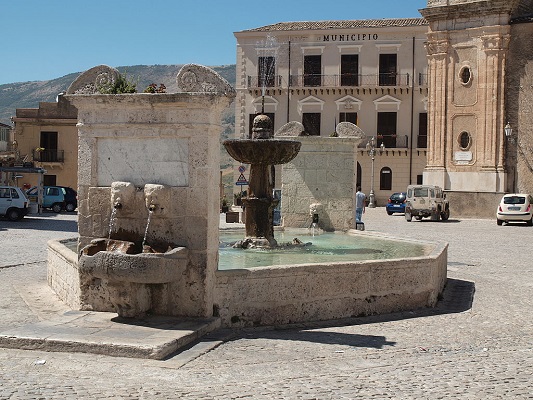
Piazza Umberto I: Used as a setting in Giuseppe Tornatore’s film Nuovo Cinema Paradiso, the town’s central square contains an octagonal fountain dating from 1608. Palazzi Dara and Mancuso are among the historic buildings around the square.
Chiesa di Maria Santissima Assunta: This Greek-Byzantine rite church faces Piazza Umberto I. Its bell tower has a sundial on its stone wall.
Chiesa di Santa Maria del Lume: Standing opposite Maria Santissima Assunta, this is the square’s Latin-rite church. The two churches reflect the distinct religious traditions maintained within Palazzo Adriano.
Lavatoio: The town’s old communal washhouse dates from 1938, during the Fascist period.
Castles
Castello di Palazzo Adriano: Remains of the castle stand in the oldest part of town, north of the central square. Narrow, winding lanes surround the ruins and the early church of San Nicolò.
Nature Sites
Riserva Naturale Orientata Monti di Palazzo Adriano e Valle del Sosio: This nature reserve encompasses the mountain and valley landscape around Palazzo Adriano. Within the municipality’s Sosio Valley, the limestone formations Pietra Salomone and Pietra dei Saraceni are distinguished by their fossil deposits.
Things to Do in Palazzo Adriano
Traditional Events
Epiphany: A traditional blessing of the waters takes place beside the octagonal fountain. A dove symbolising the Holy Spirit descends along a wire from the Byzantine church’s bell tower, and blessed oranges are distributed to those present.
Festa di San Giuseppe: On 19 March, tables are laid with breads in different shapes and other dishes. A ceremonial meal is offered to three people representing the Holy Family.
Settimana Santa: Holy Week is marked through both Latin and Greek-Byzantine traditions. Celebrations include the blessing of palms and olive branches on Palm Sunday, while the Byzantine observances begin on the preceding Friday with the commemoration of the raising of Lazarus.
Festa di San Martino: On 11 November, relatives and friends traditionally give household gifts to couples married during the year. Children carry baskets of embroidered tablecloths, presents and sweets through the streets; symbolic gifts include copper cooking vessels and specially shaped breads.
Festa di San Nicola: The celebration on 6 December includes an evening procession carrying the saint’s statue through the town. Small breads called panuzzi di San Nicola are distributed after Mass.
Museums
Museo Geo-Naturalistico del Permiano del Sosio: The museum focuses on the Sosio area’s geological and natural heritage, with displays that include casts of fossils.
Museum of Arbëreshë Culture: This museum is dedicated to the town’s Greek-Albanian cultural heritage.
Traditional Food
Gidata: A local bread speciality, gidata is flattened bread filled with vegetables.
Tabisca: This flatbread is pressed with the fingers and dressed with olive oil.
Muffoletta: Palazzo Adriano’s version of this bread is served with olive oil, pepper and ricotta.
Traditional sweets: Local sweet specialities include mastrazzole and cuddureddi made with figs and almonds. Sfince made with eggs or potatoes are also associated with the town.
Practical Travel Information for Palazzo Adriano
Driving from Palermo: Follow the SS 121 and SS 189 towards Agrigento, taking the Lercara Friddi exit onto the SS 188. Continue to the junction for Palazzo Adriano, then follow the SS 118 and SS 188, using the signs for the town.