
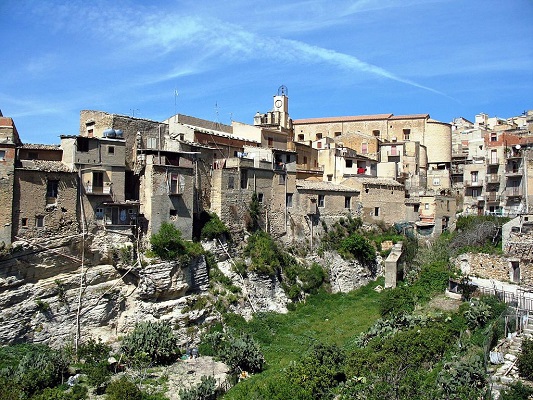
Burgio is a small hill town in Sicily’s Monti Sicani area, set to the left of the Verdura River and surrounded by a mountain landscape that still feels largely wild. Its compact medieval fabric, with narrow lanes, stairways and closely built houses, gives the village a strongly traditional character, while its artisan identity is closely tied to hand-worked terracotta and long-practised bronze bell-making.
The town’s name is linked to the Arabic word *burg*, meaning tower or fortress, a clue to the defensive origins that shaped its early identity. Burgio later developed through Norman and feudal phases, becoming one of Sicily’s major feudal centres in the 15th and 16th centuries; in 1554 Charles V raised it to a duchy and granted it the title of city.
Today Burgio is best understood as a medieval village with an unusually strong craft memory: known as a city of ceramics and marked by its old stonework and Arab-medieval street pattern, it stands out for the way landscape, feudal history and working traditions remain closely intertwined.
Patron Saint:
St. Anthony the Abbot (Sant’Antonio Abate) – 17 January
Nearest Airport:
Trapani (Birgi) – (123 km, 02:05)
Neighboring Cities:
Caltabellotta, Chiusa Sclafani, Lucca Sicula, Palazzo Adriano, Villafranca Sicula

Attractions in Burgio
Art and Architecture
Historic Centre: Burgio’s medieval street plan is particularly evident below the castle, where narrow lanes connect courtyards and stairways. The historic buildings include carved portals made from locally quarried white stone, worked by local stonemasons.
Chiesa Madre di Sant’Antonio Abate: Norman in origin, the Mother Church acquired its Renaissance appearance through later alterations. Its artworks include a Madonna and Child by Vincenzo Gagini and the wooden crucifix from the Santuario di Rifesi.
Santuario della Madonna di Rifesi: This sanctuary comprises a small Norman-style church associated with a Benedictine monastery. The church is the principal surviving religious building described within the complex.
Eremo di Santa Maria di Adriano: The remains of this medieval hermitage lie among woodland in Burgio’s surrounding countryside. Its foundation dates to the 12th century.
Castles
Castello Baronale: Burgio’s castle occupies the highest part of the village, above the tightly packed lanes of the historic centre. The fortress was rebuilt by the Normans, and the earliest settlement developed around it.
Castello di Gristia: The ruins of this 16th-century castle stand among the woods in Burgio’s wider territory. It is a separate site from the castle above the village centre.
Things to Do in Burgio
Traditional Events
Festa di Sant’Antonio Abate: Traditionally celebrated on 17 January, the feast is preceded by the lighting of a woodpile on the evening before. Customs include a procession of the saint’s statue and the blessing of animals and agricultural produce.
Festa di San Giuseppe: This March celebration includes the preparation of a meal for at least three people in need from the village. Those receiving the meal are traditionally known as the “Santi”.
Settimana Santa: On Good Friday, children dressed in white accompany the image of the dead Christ to the Calvario, playing drums and traditional instruments, before the arrival of the Madonna Addolorata. Easter Sunday brings the meeting of the Madonna and the risen Christ in the main square, together with a competition between two groups making the statues of San Vito and San Luca “dance”.
Festa Medievale del Principe Saraceno: This traditional medieval-themed festival is associated with August in Burgio.
Presepi in festa: This Christmas-period competition centres on artistic nativity scenes displayed in churches, historic palaces and other settings around the village.
Museums
Ceramics Museum: The museum is dedicated to Burgio’s ceramic tradition, which dates to the 16th century. Local maiolica is distinguished by floral and foliate decoration, male and female profiles, and a palette including straw yellow, cobalt blue, copper green and tin white.
Traditional Food
Grabuscia: This local sweet is made from fried bread dough coated in sugar.
Tabisca: Burgio’s tabisca is a flattened bread dough preparation dressed with olive oil, salt, pepper and pecorino cheese.