
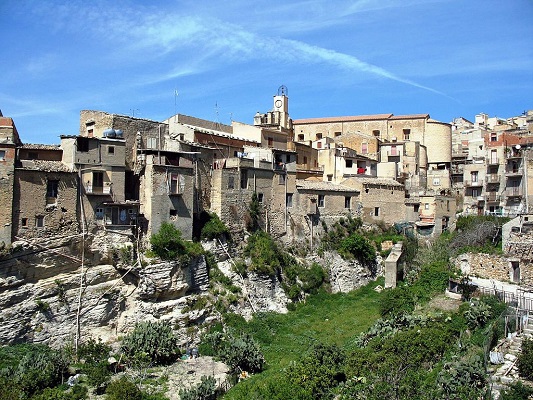
Burgio is a small hill town in Sicily’s Monti Sicani area, set to the left of the Verdura River and surrounded by a mountain landscape that still feels largely wild. Its compact medieval fabric, with narrow lanes, stairways and closely built houses, gives the village a strongly traditional character, while its artisan identity is closely tied to hand-worked terracotta and long-practised bronze bell-making.
The town’s name is linked to the Arabic word *burg*, meaning tower or fortress, a clue to the defensive origins that shaped its early identity. Burgio later developed through Norman and feudal phases, becoming one of Sicily’s major feudal centres in the 15th and 16th centuries; in 1554 Charles V raised it to a duchy and granted it the title of city.
Today Burgio is best understood as a medieval village with an unusually strong craft memory: known as a city of ceramics and marked by its old stonework and Arab-medieval street pattern, it stands out for the way landscape, feudal history and working traditions remain closely intertwined.
Patron Saint:
St. Anthony the Abbot (Sant’Antonio Abate) – 17 January
Nearest Airport:
Trapani (Birgi) – (123 km, 02:05)
Neighboring Cities:
Caltabellotta, Chiusa Sclafani, Lucca Sicula, Palazzo Adriano, Villafranca Sicula
_-_Architettura_spontanea.jpg)