
Castell’Umberto is a hill town in the Province of Messina, set in the northern Nebrodi Mountains on the north-western ridge of Monte Rocca di Poggio. Its elevated position between the fiumare of Naso and Fitalia gives it a broad mountain character, with views that open across woods, valleys, nearby villages, the Tyrrhenian Sea, the Aeolian Islands and Mount Etna.
The town’s identity is closely tied to the older settlement of Castanìa, also known as Quastània, whose memory remains central to the area’s history. In the Byzantine period the settlement had a defensive role against Saracen incursions, while the present town was founded in 1865 on safer ground after instability and landslides affected the earlier village. Its name honours Prince Umberto of Savoy, later Umberto I.
Today Castell’Umberto combines the atmosphere of a traditional Nebrodi borgo with the more ordered character of a 19th-century foundation, including an urban layout described as city-garden in spirit and local stone workmanship. Its distinctive appeal lies in this double identity: a newer hill town built for safety, still visually and historically connected to ancient Castanìa.
Patron Saint:
St. Vincent Ferrer (San Vincenzo Ferreri) – 5 April
Nearest Airport:
Catania (Fontanarossa) – (109 km, 01:56)
Neighboring Cities:
Attractions in Castell’Umberto
Art and Architecture
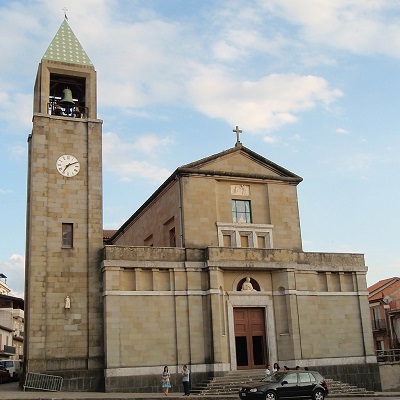
Chiesa Madre di SS. Maria Assunta: Overlooking Piazza IV Novembre, the mother church has three naves and a façade made from local sandstone. Stone quarried in the surrounding area also decorates historic buildings in the nearby streets.
Chiesa di Santa Croce: Standing on the hill of the same name, this church contains a marble statue of the Madonna and an old wooden crucifix.
Castanìa: Castell’Umberto’s abandoned predecessor retains a castle tower and the ruins of the former mother church of San Nicola di Bari. The remains of the Dominican convent and its adjoining Church of San Vincenzo Ferreri have been converted into an open-air auditorium. The surviving religious buildings also include the 16th-century Church of San Francesco.
Chiesa di Santa Barbara: Located in the old settlement of Castanìa, this church dates from 1472. Its interior contains three altars dedicated to Santa Barbara, San Gaetano and Santa Lucia.
Nature Sites
Parco Ecologico di Piano Collura: A short distance from the town, this park includes an artificial pond, picnic areas and grounds accommodating deer, including fallow deer. Its nature centre uses dioramas to depict habitats of the Monti Nebrodi.
Things to Do in Castell’Umberto
Traditional Events
Festa di San Vincenzo Ferreri: The late-August celebrations include a procession of the saint’s relics on 27 August. On 28 August, devotees carry the processional platform on their shoulders to the Serro belvedere, overlooking Castanìa and the old church dedicated to the saint. Liturgical celebrations also take place on 4 and 5 April.
Palio di San Martino: Held in November to celebrate the new wine, this traditional event centres on a contest in which participants push heavy wooden barrels. Tastings of products from the Nebrodi area accompany the competition.
Traditional Food
Nebrodi cheeses and cured meats: Regional products associated with the town include maiorchino cheese, provola dei Nebrodi and cured meats made from Nebrodi black pigs.
Practical Travel Information for Castell’Umberto
Arriving by car from Messina: Take the A20 to the Brolo–Capo d’Orlando Est exit. After passing through Brolo, follow the SS113 to the signed turning for Sinagra, then take the SP146 bis to the junction for Castell’Umberto and join the SS116.