
Biancavilla is a small historic town northwest of Catania, set on a lava-rock plateau on the slopes of Mount Etna and looking out over the Simeto Valley. Its setting gives it a distinctly Etnean character: volcanic ground, nearby wooded areas, natural springs and lava caves all form part of the landscape around the town.
Its identity is closely tied to a Greek-Albanian, or Arbëreshë, origin. The present settlement was founded in the late 15th century by Albanian refugees who arrived after the Turkish invasion of Albania; in 1488 Gian Tommaso Moncada, Count of Adernò, obtained the privilege to establish it. Earlier names such as Callicari, Pojo Rosso and Casale dei Greci reflect the layered memory of the place before it became Biancavilla in 1599, reportedly in honor of Queen Bianca di Navarra.
Today Biancavilla remains marked by religious tradition, local historical memory and its position within the wider Etna landscape. What makes it distinctive is this combination of volcanic setting and Albanian foundation story, a Sicilian town whose present character still carries the trace of a 15th-century refugee community.
Patron Saint:
Santa Maria dell’Elemosina – 4 and 5 October
Nearest Airport:
Catania (Fontanarossa) – (29 km, 00:35)
Neighboring Cities:
Adrano, Belpasso, Bronte, Castiglione di Sicilia, Centuripe, Maletto, Nicolosi, Paternò, Ragalna, Randazzo, Sant’Alfio, Santa Maria di Licodia, Zafferana Etnea

Attractions in Biancavilla
Art and Architecture
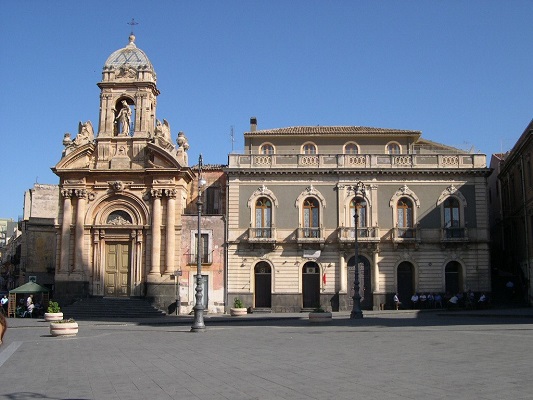
Basilica di Maria SS. dell’Elemosina: Overlooking Piazza Roma, the basilica dates from the early 16th century and was enlarged in the 18th century. Its bell tower, designed by Carlo Sada, has gold-yellow and dark-green glazed terracotta tiles. Inside are a Byzantine icon of the Madonna painted on cedar wood and paintings by Giuseppe Tamo da Brescia in the chapel of San Placido.
Chiesa di Santa Maria del Rosario: Beside the basilica stands this 17th-century church, with a Baroque façade designed by Carlo Sada. It houses an 18th-century statue of Christ at the Column by the priest and sculptor Placido Portale.
Chiesa della Beata Vergine dell’Angelo Annunziata: Frescoes decorate the central vault, transept and presbytery of this church, making its painted interior its principal feature of interest.
Chiesa di Santa Maria della Mercede: This church contains works by Giuseppe Tamo da Brescia, whose paintings also feature in several other religious buildings in Biancavilla.
Convento di San Francesco: The convent’s cloister is decorated with frescoes by Giuseppe Tamo da Brescia. In the adjoining church, Olivio Sozzi painted the Assumption of the Blessed Virgin Mary with the Holy Trinity in 1759, while Sebastiano Lo Monaco created the Apotheosis of Saint Francis on the presbytery vault.
Chiesa di Santa Maria dell’Idria: The altarpiece in this church is the Madonna del cammino, painted in the second half of the 19th century by Biancavilla-born artist Placido Rapisarda. Its dedication reflects the devotion to the Madonna dell’Odigitria introduced by the town’s Albanian community in the 15th century.
Nature Sites
Parco dell’Etna: Part of Biancavilla’s territory lies within the park. The surrounding volcanic countryside includes woodland and nature trails, offering a contrast to the town’s built-up centre.
Grotta degli Archi: Also known as Grotta del Monte Pecoraro, this lava cave lies on Etna’s south-western slope and forms part of the volcanic landscape associated with Biancavilla.
Piano Mirio: Within the municipal pine woodland, Piano Mirio has a small barracks building and outdoor areas equipped for picnics.
Things to Do in Biancavilla
Traditional Events
Carnevale di Biancavilla: The town’s carnival traditions include costumed parades, allegorical floats, music in the squares and entertainment.
Settimana Santa: Holy Week begins with a live enactment of the Stations of the Cross on Palm Sunday, followed by the Good Friday procession of the Misteri. On Holy Saturday night, the “calata da tila” ceremony unveils the figure of the risen Christ; Easter Sunday brings the traditional encounter between the figures of Christ and the Virgin Mary in the town’s squares.
Festa di Maria SS. dell’Elemosina: Traditionally celebrated on the last Sunday in August, the feast includes a procession with the venerated image of the Madonna after solemn Mass outside the basilica. A further procession marks the celebration on 4 October, while the liturgical feast falls on 10 October.
Rievocazione storica Arbëreshë: Held during the October patronal celebrations, this historical procession recalls the arrival of the Albanian community. Participants in period costume pass through the centre and finish at the Basilica di Maria SS. dell’Elemosina.
Festa di San Placido: Religious services and a procession with the saint’s statue traditionally take place on 5 and 6 October. The feast forms part of Biancavilla’s “Ottobre Sacro”, a cycle of religious celebrations ending on 10 October.
Museums
Museo della Satira di Costume: Housed in Villa delle Favare, the museum features drawings by cartoonist Giuseppe Coco, whose family origins were in Biancavilla. The former aristocratic residence also houses the municipal library and serves as a cultural centre.
Traditional Food
Scumuni: This local artisan ice cream combines chocolate and zabaglione flavours.
Bersagliere: A chocolate-coated biscuit, the bersagliere is one of Biancavilla’s traditional sweet specialities.
Mastazzoli: These local sweets are made with prickly pears from Etna, linking the town’s confectionery to a characteristic crop of the surrounding countryside.
Frascatuli: Biancavilla’s frascatuli are a polenta-like preparation made with pulse flours. The tradition is associated with milling chickpeas, beans and lentils for use in cooking during times of scarcity.
Local agricultural produce: The surrounding territory produces Arancia Rossa di Sicilia IGP blood oranges, including Tarocco, Moro and Sanguinello varieties, and Ficodindia dell’Etna DOP prickly pears. Other local products include extra virgin olive oil made from Nocellara Etnea olives and wine from Etna vineyards.
Practical Travel Information for Biancavilla
Getting There by Car: From Catania, follow the SS121 towards Paternò, then continue on the SS284 towards Biancavilla.