
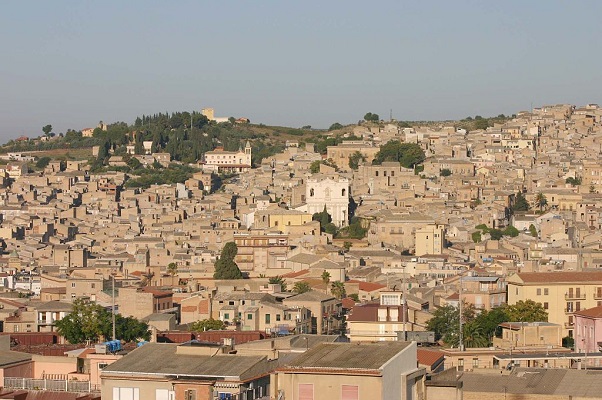
Canicattì is a hilly town in the Province of Agrigento, set between Agrigento and Caltanissetta at around 420 metres above sea level. Its surrounding cultivated hills and vineyards form an amphitheatre-like landscape, giving the town a strong agricultural identity and a close connection with the land, water sources and rural work.
Its medieval character is still central to its identity, with an old urban fabric of narrow streets, courtyards and aristocratic traces. The origin of its name is not certain, though local traditions connect it with Arabic forms, reflecting the broader historical layers that shaped this part of Sicily.
The town’s medieval story is often linked to a 14th-century foundation by the Palmeri family of Naro, while a later defining phase came in 1619, when Prince Giacomo I Bonanno acquired the barony and reshaped Canicattì’s urban development. Today, Canicattì stands out for the way its Arab-linked memory, feudal past and vineyard landscape combine in a distinctly inland Sicilian setting.
Patron Saint:
Saint Pancras (San Pancrazio) – 3 April
Nearest Airport:
Comiso (Pio La Torre) – (111 km, 01:44)
Neighboring Cities:
Serradifalco, Montedoro, Caltanissetta, Delia, Castrofilippo, Racalmuto, Naro

Attractions in Canicattì
Archaeological Sites
Vito Soldano: This archaeological area lies 6 km from the town centre and preserves remains from the Roman and Byzantine periods. Excavations have uncovered settlement remains and finds spanning several historical periods.
Art and Architecture
Chiesa Madre di San Pancrazio: Canicattì’s mother church stands in the historic centre. Its façade was designed by Ernesto Basile.
Chiesa di San Diego: Situated at Largo Savoia, where Corso Umberto begins, this church contains 18th-century stucco decoration.
Fontana del Nettuno: Set against the Chiesa del Purgatorio, this fountain depicts Neptune and is locally called “Petreppàulu”. It was one of three fountains commissioned by Giacomo I Bonanno.
Chiesa di San Francesco: This historic church is distinguished by its fresco decoration.
Teatro Sociale: Built in 1889 to a design by Ernesto Basile, the theatre occupies the site of a former Carmelite convent. Its architectural features include Doric columns, wrought-iron gates and decorated windows.
Villa Ferriato: Located outside the town centre in Contrada Ferriato, this 19th-century villa was commissioned by Baron Francesco Lombardo and designed by Ernesto Basile. It is an example of Liberty architecture, the Italian expression of Art Nouveau.
Santuario della Madonna della Rocca: This sanctuary is a pilgrimage destination with an adjoining Capuchin convent.
Things to Do in Canicattì
Traditional Events
Festa di Li Tri Re: Held for Epiphany on 6 January, this celebration features the Three Kings arriving on horseback at a Nativity scene in the main square. The representation concludes with the Holy Family’s flight into Egypt, accompanied by bagpipes and bells.
Festa di San Calogero: Traditionally celebrated on the first Sunday in August, the feast includes an afternoon procession and the distribution of blessed bread.
Sagra dell’Uva Italia: Also described as the Sagra dell’Agricoltura, this October celebration is dedicated to the local table-grape harvest and takes place in the squares of the historic centre.
Traditional Food
Uva da Tavola di Canicattì IGP: Table grapes of the Italia cultivar are a major local agricultural product. The grapes carry IGP protected geographical indication status.
Quadrelli: These local sweets consist of layers of crunchy almond brittle finished with chopped pistachios.
Practical Travel Information for Canicattì
Getting There by Car: Canicattì is reached from the SS640 Agrigento–Caltanissetta road using the turn-off for the town, with connections via the SS122 and SS123.