
Delia is a historic inland town near Caltanissetta, set on the slope of Monserrato hill in a landscape of surrounding hills, almond trees and olive groves. Its hillside form gives it a compact, amphitheatre-like character, while its identity remains closely tied to rural life, local memory and community religious traditions.
The present town took shape in 1597, when Baron Gaspare Lucchese founded it with a Spanish-era *licentia populandi*, making Delia one of Sicily’s planned “new towns” of the late 16th and early 17th centuries. Its ordered, orthogonal layout reflects that phase, although the site’s story reaches much further back, to a Roman *statio* known as Petiliana and to medieval casale history. The origin of the name Delia is uncertain, with traditions linking it either to the ancient world or to an Arab term associated with vineyards.
This mix of planned Spanish urbanism, older settlement memory and agricultural inland setting gives Delia a distinctive place among Sicily’s smaller historic towns.
Patron Saint:
Saint Rosalia (Santa Rosalia) – 4 September
Nearest Airport:
Comiso (Pio La Torre) – (102 km, 01:36)
Neighboring Cities:
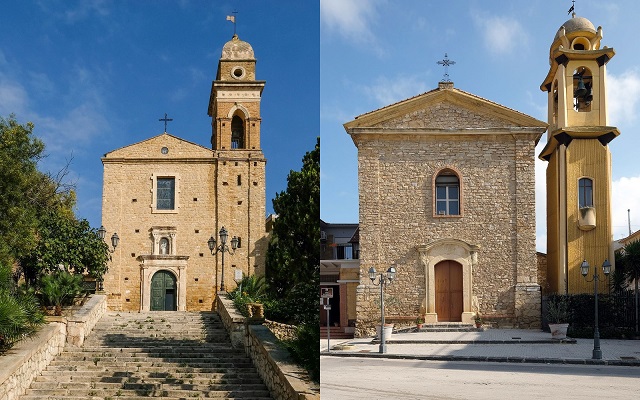
Attractions in Delia
Art and Architecture
Piazza Castello: The square contains an obelisk commemorating the 400th anniversary of Delia’s foundation. Bronze relief panels on its four sides, created by Salvatore Montebello, depict the community’s civil and cultural history.
Chiesa Madre di Santa Maria di Loreto: Standing in Piazza Castello, Delia’s mother church has origins in the fourteenth century and was rebuilt and enlarged in the eighteenth century. Its artworks include a painting of Santa Rosalia by Pietro D’Asaro and a statue of the Madonna delle Grazie by Filippo Bagnasco.
Chiesa di Sant’Antonio Abate: In the historic quarter known as the “Ebrei”, the present church was built between 1740 and 1763 to replace an earlier building. Its interior contains five Baroque chapels with carved wooden altars.
Chiesa della Madonna del Carmelo: Founded in 1601 by Baron Gaspare Lucchese alongside a Carmelite convent, this church retains stucco decoration and frescoes despite several reconstructions. Its main entrance is made from local white limestone.
Chiesa di Santa Maria dell’Itria: The church preserves an old wooden statue of the Madonna d’Itria and a statue of the Saviour attributed to Bagnasco, carved around 1755. The latter is carried in Delia’s Easter Sunday procession.
Castles
Castello di Sabuci: Also known locally as “lu castiddrazzu”, the ruined fortress stands on a steep rocky hill just outside Delia’s built-up centre. It overlooks the surrounding valley and once controlled the historic route between Agrigento and Catania.
Things to Do in Delia
Traditional Events
Festa di San Giuseppe: Delia celebrates San Giuseppe in both March and August. March traditions include a procession of the Holy Family, Mass in the Chiesa Madre and a communal table of shared food; the August celebrations include the “Tuppi tuppi” ritual and a procession with the saint’s statue.
Settimana Santa: On Good Friday, statues of the Addolorata and San Giovanni accompany the bier of the dead Christ in a procession with funeral marches and traditional songs performed by the “lamentatori”. Easter Sunday brings the Incontro, when the statues of the risen Christ and the Madonna approach and exchange three symbolic kisses.
Festa di Santa Rosalia: The traditional celebration on 4 September includes a torchlit procession accompanying the saint’s relic through Delia, with music from the town band.
Traditional Food
Cuddrireddra: This ring-shaped fried sweet is a distinctive Delia speciality. Traditionally associated with Carnival, it is also eaten throughout the year.
Places to Visit Near Delia
Santa Rita: This village in the territory of Caltanissetta stands on a rocky spur at the foot of Monte Pisciacane. Its bread-making tradition uses stone-ground ancient Sicilian grains and wood-fired ovens.
Practical Travel Information for Delia
Arriving by Car: From Agrigento, follow the SS640 towards Caltanissetta and take the Canicattì nord–Delia exit.