
Cefalù is a historic seaside town on Sicily’s northern Tyrrhenian coast, set at the foot of the rocky promontory known as the Rocca. Its old centre keeps the scale of an ancient fishing village, with low houses close to the sea and narrow lanes that climb and fall between the waterfront and the rock behind it.
The town’s roots reach back to pre-Hellenic times, and in antiquity it was known as Kephaloidion. Although its history is long, Cefalù gained particular importance during the Norman period, which remains central to its cultural identity. Today its character comes from the close meeting of sea, stone, old urban fabric and Norman memory, making it one of the most distinctive coastal towns in northern Sicily.
Patron Saint:
Immacolata Concezione – 8 December
Nearest Airport:
Palermo (Falcone-Borsellino) – (100 km, 01:24)
Neighboring Cities:

Attractions in Cefalù
UNESCO Sites
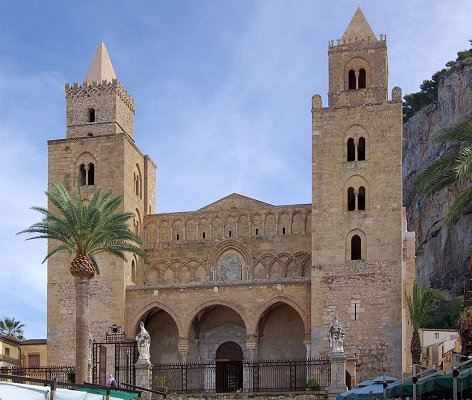
Cattedrale di Cefalù: Founded by Roger II in 1131, Cefalù’s Norman cathedral forms part of the UNESCO-listed Arab-Norman heritage of Palermo and the cathedrals of Cefalù and Monreale. Its mosaics are a principal feature, while two massive bell towers give the façade a fortress-like appearance above Piazza Duomo.
Art and Architecture
Lavatoio Medievale: This historic communal washhouse stands among the streets of the old town. It preserves a place where local women washed clothes until comparatively recent decades.
Chiesa del Purgatorio: On Corso Re Ruggero, this church has a distinctive portal framed by columns carved with figures of souls in purgatory.
Santuario di Gibilmanna: Dedicated to the Virgin Mary, this sanctuary stands on the slopes of Pizzo Sant’Angelo, at an altitude of 795 metres. Its Sicilian Baroque architecture is set within the landscape of the Madonie.
Nature Sites
La Rocca: The rocky promontory rising above Cefalù reaches around 270 metres and offers views across the town. Its historic remains include the Tempio di Diana and the ruins of the medieval Castello di Cefalù, built to defend the settlement.
Beaches
Spiaggia del Lungomare: Cefalù’s sandy town beach runs beside the seafront, close to the old fishing settlement.
Spiaggia di Mazzaforno: Mazzaforno is one of Cefalù’s coastal beach areas, beyond the town-centre seafront.
Spiaggia di Capo Plaia: Capo Plaia provides a broad, sandy stretch of Cefalù’s coastline.
Things to Do in Cefalù
Traditional Events
Festa del SS. Salvatore: Traditionally held from 2 to 6 August, the celebration begins with a banner depicting Christ Pantocrator displayed between the cathedral towers. The final day features the ’ntinna a mari, a greased-pole contest over the sea, followed by a procession and fireworks.
Festa della Madonna di Gibilmanna: Held on the first Sunday in September at the sanctuary, this celebration includes a procession with the statue of the Madonna. Offerings include oil for the lamp kept at the foot of her image.
Festa dell’Immacolata: The traditional celebration on 8 December includes a floral tribute and an afternoon procession, followed by a solemn Mass in the cathedral.
Museums
Museo Mandralisca: The museum occupies the eighteenth-century Palazzo dei Baroni di Mandralisca in Cefalù’s historic centre.
Gibilmanna Convent Museum: Housed in the former stable of the convent adjoining the sanctuary, this museum brings together sacred furnishings, vestments, paintings and objects associated with Franciscan culture.
Practical Travel Information for Cefalù
Arriving by Car: The road approach from Palermo uses the A19 and A20 motorways, leaving at the Cefalù exit.
Arriving by Train: Cefalù can be reached by rail from Palermo, Catania and Trapani; these journeys should not all be assumed to be direct.