
Forza d’Agrò is a small historic hill village in the Province of Messina, set in the Valle d’Agrò on the south-eastern slopes of the Peloritani Mountains. From about 420 metres above sea level, it looks out over the Ionian coast, with the compact form of a medieval borgo gathered between mountain and sea.
Its identity reaches back well before the Middle Ages, but the first historical references place the settlement in the 10th century under the name Vicum Agrillae. Later known as Agrille and then Fortilicium d’Agrò, it was linked to Norman Sicily when King Roger II donated the village in 1116 to the abbot of a local religious community. After the older settlement was destroyed by the flood of 1169, the present village was rebuilt around 1300.
Today Forza d’Agrò retains the close-knit texture of its medieval layout, with narrow lanes, stone stairways, courtyards and balconies facing the coast. Later noble and baroque phases add to its character, while its international cinematic memory gives this quiet hilltop village a distinctive place in Sicily’s cultural imagination.
Patron Saint:
Maria SS. dell’Annunziata – 25 March
Nearest Airport:
Catania (Fontanarossa) – (91 km, 01:11)
Neighboring Cities:
Casalvecchio Siculo, Gallodoro, Letojanni, Limina, Mongiuffi Melia, Sant’Alessio Siculo, Savoca

Attractions in Forza d’Agrò
Art and Architecture
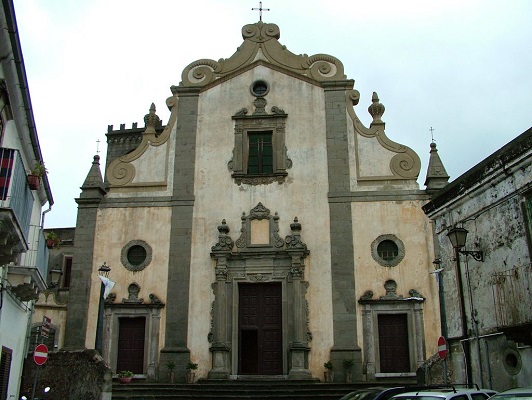
Chiesa della Santissima Annunziata: The mother church overlooks its namesake square with a Baroque-style façade and a tall, crenellated bell tower. Its artworks include a crucifix painted on wood, a 16th-century statue of Santa Caterina d’Alessandria by Martino Montanini and an Annunciation attributed to Stefano Giordano.
Chiesa della Santissima Trinità: This church forms part of the architectural complex overlooking Piazza della Triade, alongside the former Augustinian convent. It contains works associated with the school of Antonello da Messina.
Arco Durazzesco: This Catalan Gothic gateway leads into Piazza della Triade, providing a distinctive architectural approach to the church and former convent complex.
Historic Centre: Below the castle, the medieval street plan consists of narrow lanes, stairways and small courtyards between closely packed houses, many built from sandstone. Palazzo Mauro, Palazzo Miano, Palazzo Bondì and Palazzo Garufi belong to the later development of aristocratic residences in the 17th and 18th centuries.
Castles
Castello di Forza d’Agrò: Also called Castello Argano, the ruined fortress occupies the rocky summit above the village, approached by a long, steep stone staircase. Surviving features include the enclosing walls and the remains of the Chiesa del Santissimo Crocifisso with its bell tower.
Things to Do in Forza d’Agrò
Traditional Events
Carnevale Forzese: The village’s Carnival celebrations feature live music and group dancing.
Festa dell’Alloro: Held on Easter Monday in honour of the Santissima Trinità, this celebration includes processions carrying standards made from bay leaves and sacred oils.
Festa della Santissima Trinità: Traditionally held on the first Sunday of June in alternate years, the feast also involves the neighbouring community of Gallodoro. Confraternities from both villages take part, with celebrations culminating in an evening procession of the Santissima Trinità on a ceremonial platform.
Festa del Santissimo Crocifisso: Celebrated on 14 September, the feast centres on the crucifix kept in the mother church. It is carried through the village on a small ceremonial platform, accompanied by the confraternity and local authorities.
Christmas Traditions: Local Christmas celebrations include a living nativity in the old village, with participants in period costume. Seasonal markets feature handmade crafts, local food products and handcrafted nativity scenes.
Museums
CioccolArt Sicily Museum: The museum is housed in the former Convento Agostiniano, part of the complex beside the Chiesa della Santissima Trinità. The convent’s architectural features include a cloister and a crypt.
Traditional Food
Cuddura cu l’ova: This Easter speciality is part of Forza d’Agrò’s pastry tradition. Blessed cuddure are also distributed during the Festa dell’Alloro.
Practical Travel Information for Forza d’Agrò
Getting There by Car: From Messina, take the A18 exit at Roccalumera and follow the SS114 towards Catania. From Catania, leave the A18 at Taormina and follow the SS114 towards Messina. Both approaches lead to the junction at Capo Sant’Alessio, where the SP16 climbs towards Forza d’Agrò.