
Syracuse is a historic coastal city in south-eastern Sicily, set on the Ionian Sea with Ortigia as its oldest island core. Its identity is inseparable from the water, from its seafront position and ports to the layered urban fabric where ancient, medieval and baroque phases still define the city’s character.
Founded in the 7th century BC by Corinthian colonists, who called it Syraka, Syracuse became one of the great cities of Magna Graecia and an important centre of the ancient Mediterranean. Its later history passed through Roman, Byzantine, Arab, Norman and medieval periods, before major renewal followed the earthquake of 1693, especially in Ortigia.
Today, Syracuse is distinctive for the depth of that continuity: a UNESCO-protected city where Greek origins, Christian memory, baroque rebuilding and coastal life remain closely bound together. Its appeal lies not in a single period, but in the way three millennia of Mediterranean history still shape the atmosphere of a living Sicilian city.
Patron Saint:
Saint Lucy (Santa Lucia) – 13 December
Nearest Airport:
Catania (Fontanarossa) – (79 km, 01:05)
Neighboring Cities:
Avola, Canicattini Bagni, Floridia, Melilli, Noto, Palazzolo Acreide, Priolo Gargallo, Solarino

Attractions
Artemision – google maps
Catacombs of San Giovanni – google maps
Catacombs of Vigna Cassia – google maps
Catacombs of Santa Lucia – google maps
Hypogeum of Piazza Duomo – google maps
Neapolis Archaeological Park – Hosts the most important ruins of the old Greek Roman city of Syracuse. – google maps
Necropolis of Cassibile – google maps
Parco del Foro Siracusano – google maps
Roman Gimnasium – google maps
Stentinello – google maps
Tomba di Archimede – google maps
Fontane Bianche Beach – google maps
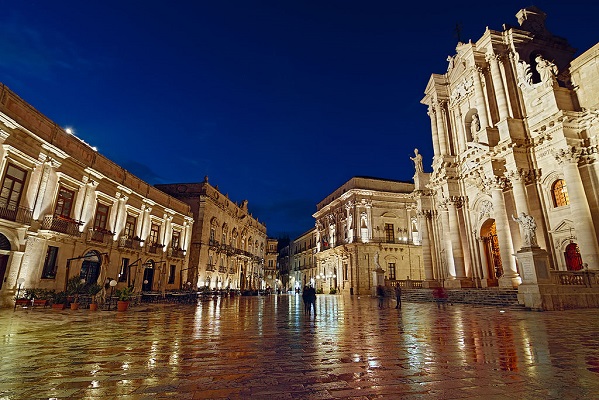
Cathedral of Syracuse – google maps
Cavagrande Del Cassibile Reserve – google maps