
Cerda is a small rural village in inland Sicily, set on the hilly margins of the Madonie between the valleys of the Northern Imera and Torto rivers. Its landscape is one of cultivated slopes, open countryside and, in the wider territory, woods, watercourses and small lakes, giving the village a strongly agricultural character rooted in the rhythms of the land.
Its origins are not defined with certainty, but Cerda developed as a feudal settlement under noble families between the 16th and 17th centuries. The surrounding area also preserves the memory of much older occupation, reaching back to archaic and classical times, while the village later became associated with Sicily’s early motoring age through the nationally important race created by Vincenzo Florio in 1906.
Today, Cerda’s identity rests on this unusual combination of inland farming culture, noble-period origins and sporting memory. More than a generic hill village, it is a place where rural Sicily, feudal history and 20th-century road-racing heritage meet in a compact Madonie-edge setting.
Patron Saint:
Maria Santissima Addolorata – 16 August
Nearest Airport:
Palermo (Falcone-Borsellino) – (87 km, 01:20)
Neighboring Cities:
Aliminusa, Collesano, Sciara, Scillato, Sclafani Bagni, Termini Imerese

Attractions in Cerda
Art and Architecture
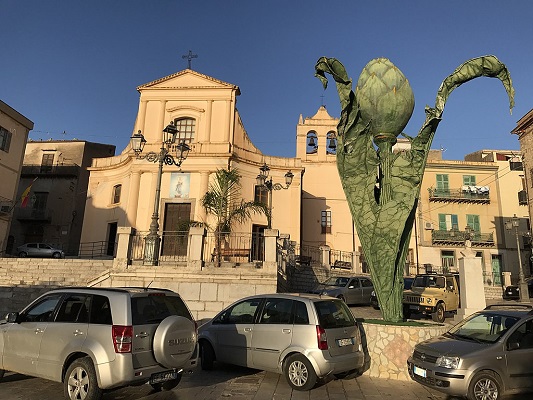
Piazza Vito La Mantia: Cerda’s main square spreads across several levels linked by stairways, giving it an amphitheatre-like arrangement. The town hall is among the buildings overlooking it.
Monumento al Carciofo: This seven-metre-high monument in Piazza Vito La Mantia celebrates the artichoke, a distinctive crop of the surrounding countryside. It was created by sculptor Dino Pantano in 1987.
Chiesa Madre: Dedicated to Maria Santissima Immacolata, Cerda’s mother church occupies an elevated position above Piazza Vito La Mantia.
Palazzo Russo: Standing beside the Chiesa Madre, this historic palace has nineteenth-century frescoes decorating its ballroom.
Chiesa di Maria Santissima dei Miracoli: This church stands in the upper part of Cerda and is a focus of local devotion to the Madonna dei Miracoli.
Chiesa della Madonna della Catena: Just outside the built-up centre, in contrada Baiata, this small church dates from the late nineteenth century and is a local pilgrimage destination.
Abbazia di Santa Maria di Burgitabis: The remains of this Norman-era Benedictine abbey lie near the rural settlement of Villaurea. The religious community occupied the abbey until the eighteenth century.
Tribune di Floriopoli: The historic grandstands near Cerda recall the Targa Florio motor race, established by Vincenzo Florio in 1906. Spectators gathered here to watch the race, whose course followed the winding roads of the Madonie.
Nature Sites
Riserva Naturale Orientata Bosco della Favara e Bosco Granza: Part of Cerda’s territory lies within this nature reserve. Its landscape includes cork oak and downy oak woodland, watercourses and lakes.
Things to Do in Cerda
Traditional Events
Carnevale Cerdese: Cerda’s Carnival celebrations feature groups in costume and allegorical floats parading through the streets, culminating in a celebration in the square.
Festa di San Giuseppe: Celebrated on 19 March, the feast includes a procession with the saint’s statue, the Virgineddi tradition and the communal Tavulata di San Giuseppe in the square.
Settimana Santa: Holy Week observances begin on Palm Sunday. Good Friday includes a town Via Crucis followed by the traditional Rincuontru between the Madonna Addolorata and the dead Christ; a dramatisation of the Passion also takes place in the square during the days before Easter.
Sagra del Carciofo: Traditionally held on 25 April, Cerda’s artichoke festival combines tastings with folk music, dancing, historical processions and performances.
Festa della Madonna Addolorata: The 16 August celebration includes an evening procession with the statue of the Madonna Addolorata and fireworks.
Festa della Madonna della Catena: This feast is traditionally held on the last Sunday in August at the small church in contrada Baiata.
Festa della Madonna dei Miracoli: On 8 September, celebrations honour the Madonna dei Miracoli at the church dedicated to her in the upper part of town.
Mercatino di Natale: Cerda’s traditional Christmas market takes place in the main square before the Christmas festivities, with local produce and handmade crafts.
Museums
Museo della Targa Florio: Housed in the former Motel Aurim, where drivers gathered during the week before the race, this museum traces the history of the Targa Florio through documents and memorabilia. Its collection includes items that belonged to the Florio family.
Traditional Food
Carciofo spinoso cerdese: The locally grown spiny artichoke is central to Cerda’s culinary identity. Cultivated across the surrounding countryside, it is prepared in a wide variety of local dishes.