
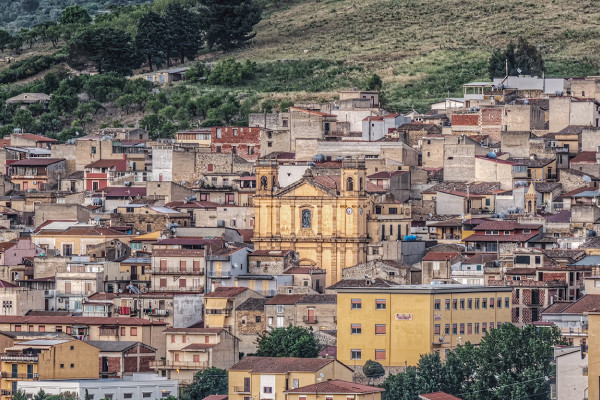
Baucina is a small historic village in inland Palermo, set in a hilly landscape where mountains frame views that can reach toward the sea. Part of its territory lies within the natural area of Pizzo Cane, Pizzo Trigna and Grotta Mazzamuto, giving the village a close relationship with the countryside around it. Its old fabric is marked by stepped streets and an upper nucleus known as Capo or Testa dell’Acqua, a name recalling the presence of springs.
The area was inhabited from prehistoric times, while the modern settlement grew from a rural community in the feud of San Marco. In 1624 Don Mariano Migliaccio Conti obtained the *licentia populandi* that formalised the development of the present village, and soon after the feud was raised to a principality under King Philip IV of Spain. Today Baucina’s identity rests on this mix of ancient traces, feudal origins, agricultural memory and strong local devotion, especially to Santa Fortunata.
Patron Saint:
Santa Fortunata – 12 September
Nearest Airport:
Palermo (Falcone-Borsellino) – (66 km, 01:05)
Neighboring Cities:
Bolognetta, Caccamo, Casteldaccia, Ciminna, Ventimiglia di Sicilia, Villafrati
Attractions in Baucina
Archaeological Sites
Monte Falcone and Monte Carrozza: These two hills belong to an archaeological area with evidence of settlement dating to the sixth century BC. The necropolis on the southern slope of Monte Falcone includes rock-cut chamber tombs and tile-covered graves; a large chamber tomb has a rock-cut approach corridor and an entrance framed by gypsum pillars and a lintel.
Art and Architecture
Chiesa Madre di Santa Rosalia: Founded in 1626 and subsequently rebuilt, Baucina’s mother church has an interior decorated with stucco, marble, statues and altars. Its artworks include an eighteenth-century crucifix by the sculptor Filippo Quattrocchi.
Chiesa della Madonna del Lume: Attached to the Collegio di Maria, this church houses a wooden statue of the Addolorata and an altarpiece depicting Maria Santissima del Lume from the first half of the eighteenth century. The relics of Santa Fortunata are kept here in an ornate urn.
Chiesa di San Marco: Built in the sixteenth century by Don Antonio Ventimiglia, this church stands in the San Marco district just outside the town. It houses a statue of Saint Mark the Evangelist.
Historic Centre: Baucina’s older streets retain characteristic stepped climbs, including the one at Largo Giovanni XXIII. The oldest quarter, Capo or Testa dell’Acqua, occupies the upper part of the town, with a name recalling the presence of springs.
Nature Sites
Riserva Naturale Orientata di Pizzo Cane, Pizzo Trigna e Grotta Mazzamuto: The mountainous part of Baucina’s territory falls within this nature reserve, extending the destination’s natural setting beyond the built-up town.
Things to Do in Baucina
Sport
Attraverso la natura: This five-kilometre walking route starts in Baucina and leads to the cork oaks of Suvarita. The route takes in the surrounding landscape, with views towards the mountains and the sea.
Traditional Events
Carnevale di Baucina: Baucina’s carnival traditions include a costumed parade through the town and masked evening celebrations.
Festa di San Giuseppe: Celebrated in March, this feast includes the Tavolata di San Giuseppe, representations of the Flight into Egypt and the volata degli Angeli, followed by an evening procession. Associated food celebrations include the Sagra della sfincia di San Giuseppe and BauCibus, dedicated to local products.
Settimana Santa: On Maundy Thursday, a procession carrying the Cross moves between the town’s churches, accompanied by traditional Baucina Easter laments. Good Friday includes a procession taking the dead Christ to the Calvario and an evening procession with Maria Santissima Addolorata.
Festa di San Marco Evangelista: Held on 25 April, the celebration includes an evening procession through the main streets before the statue returns to the Chiesa di San Marco. The festivities also feature an agricultural equipment fair and the Festival del Gusto, with local food tastings.
Festa del Santissimo Crocifisso: The second Sunday in May brings an equestrian procession, the ritual known as the furriata di li torci, a religious procession and the volata degli Angeli. Local food celebrations also form part of the festivities.
Festa del Grano: Held on the last Sunday in August, this celebration recalls the area’s agricultural traditions. Baucina Street Food accompanies the festival, highlighting local products.
Festa di Santa Fortunata: On the second Sunday in September, the urn containing Santa Fortunata’s relics is carried in procession. Participants in period costume precede it through the town.
Festa dell’Immacolata: During the night of 7–8 December, the statue known locally as ra’ mmaculatedda is carried through the streets with torches and a musical band. The procession is followed by the Messa dell’Aurora, or dawn Mass.
Museums
Museo Archeologico: Baucina’s archaeological museum brings together finds from the surrounding territory and its archaeological sites. Its collections also include rocks and fossils representing the area’s geological formations.
Traditional Food
Cuddiruni and cuddiruneddu fritto: Baucina’s local specialities include white and red versions of cuddiruni, alongside the fried cuddiruneddu.
Local agricultural products: Meat, local sausage, olive oil, cheeses and ricotta feature among Baucina’s traditional foods, reflecting the area’s farming and livestock-rearing economy.
Buccellati and almond sweets: Buccellati and almond-based sweets form part of Baucina’s baking traditions, alongside sweet specialities prepared for local celebrations.
Practical Travel Information for Baucina
Getting There by Car: From Palermo, take the SS121 and leave at the exit signposted for Baucina, then follow the SP6 towards the town.