
Francofonte is a small historic agricultural town in the Province of Syracuse, in southeastern Sicily. Perched on a hillside on the northern foothills of the Hyblaean Mountains, it looks out over the fertile Plain of Catania, with citrus groves and vineyards defining much of the surrounding countryside.
The present town has medieval origins and developed from a fortified nucleus established in the 14th century, around 1360, by Artale Alagona in the fief of Bufilda. Its history later passed through important feudal phases, including strong growth under the Cruyllas family, before the town was badly affected by the earthquake of January 1693 and subsequently reshaped.
Today Francofonte’s character is closely tied to its elevated setting, rural economy and devotional traditions. Known as the “City of citrus”, it stands out as a hillside town where medieval foundations, noble feudal history and an enduring agricultural identity remain closely connected.
Patron Saint:
Madonna della Neve – 5 August
Nearest Airport:
Catania (Fontanarossa) – (40 km, 00:45)
Neighboring Cities:
Buccheri, Carlentini, Lentini, Militello in Val di Catania, Vizzini

Attractions in Francofonte
Art and Architecture
Chiesa Madre di Sant’Antonio Abate: Standing in Piazza Vittorio Emanuele III, Francofonte’s mother church was rebuilt in the late seventeenth century following the 1693 earthquake. Its interior contains decorated altars, side chapels and Corinthian capitals.
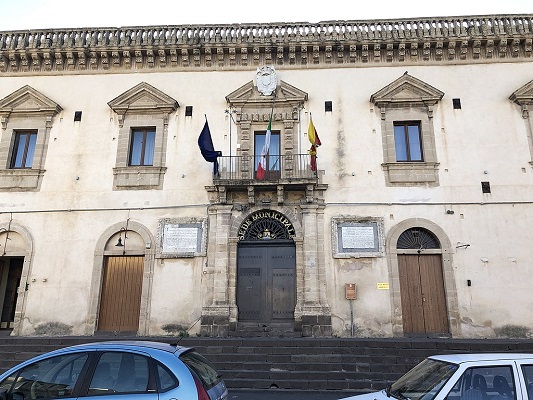
Palazzo Gravina-Cruyllas: This palace in Piazza Garibaldi houses the town hall and incorporates part of the medieval castle. Two circular towers survive from the earlier structure, while the palace façade features decorative masks, two corner balconies and a balustraded cornice.
Chiesa di San Girolamo: Built in 1694, this was the first church reconstructed after the earthquake and served as the mother church until 1699. Its interior has ceramic flooring from Caltagirone, and the historic Torre dell’Orologio stands alongside it.
Chiesa dell’Angelo Custode: The church contains an old statue of the Addolorata, a seventeenth-century statue of the Immacolata and an eighteenth-century painting depicting the martyrdom of Sant’Agata.
Chiesa del Carmine: This church houses statues of the Madonna del Carmelo, Santa Lucia and San Sebastiano, reflecting several strands of Francofonte’s religious traditions.
Chiesa di Sant’Antonio di Padova: The church is distinguished by its Gothic entrance portal.
Fonte Giardinello: Dating from 1896, this fountain is one of Francofonte’s historic water features and a local landmark associated with the town’s collective memory.
Santuario dell’Annunziata: Just outside the built-up centre, this sanctuary was formerly the convent church of the Frati Minori Riformati. It preserves a painting of the Annunciation that is a focus of local devotion.
Chiesa di Santa Maria di Soleto: In contrada Passaneto, this church forms part of a cave sanctuary. A natural grotto reached from the interior is associated with the legend of the discovery of an image of the Madonna della Neve, represented there by a ceramic image on lava stone.
Castles
Castello di Chadra: Also called Castello di Gàdera, these castle ruins stand among citrus groves and vineyards in contrada Gàdera. The castle was built in the fourteenth century by Giovanni de Lamia of Lentini.
Things to Do in Francofonte
Traditional Events
Carnevale di Francofonte: The town’s carnival celebrations include masked school parades, dancing and performances in Piazza Dante, together with a procession of allegorical floats through the centre.
Viaggi dell’Annunziata: These traditional pilgrimages to the Santuario dell’Annunziata take place between 2 February and 25 March. The faithful visit to offer prayers and vows, greeting the painting of the Annunciation on arrival.
Festa di San Giuseppe: Celebrated in March, this feast includes a cart carrying gifts in honour of San Giuseppe and a procession of the Holy Family through the historic centre along the traditional Giro dei Santi route.
Settimana Santa: Holy Week includes the procession of Cristo alla Colonna on Maundy Thursday and those of Cristo Morto and the Addolorata on Good Friday. On Easter Sunday, the “Incrinata” brings together the risen Christ and the Madonna della Pace in Piazza Garibaldi.
Festa di San Sebastiano: Held on the last Sunday of May, the feast includes two processions of the saint’s statue: a morning procession along the Giro dei Santi route and an afternoon procession following solemn Mass.
Festa della Madonna della Neve: The celebration reaches its central moment at noon on 5 August, when the processional platform leaves the Chiesa Madre. A symbolic presentation of the town’s keys forms part of the ceremony.
Sagra del Tarocco: This festival celebrates Francofonte’s blood-orange production, with the Tarocco variety at its centre.
Fiera dell’Artigianato e del Commercio: This local fair brings together crafts and trade, including handmade objects offered for sale.
Traditional Food
Blood oranges: Citrus cultivation is central to Francofonte’s agricultural identity. Tarocco, Moro and Sanguinello are among the blood-orange varieties grown locally, with Tarocco particularly associated with the town.
’Mpanate: These filled, calzone-style pastries are part of Francofonte’s traditional cooking, prepared according to established local recipes.
Maccarruni and cavateddi: These handmade fresh pasta shapes feature in the town’s culinary tradition.