
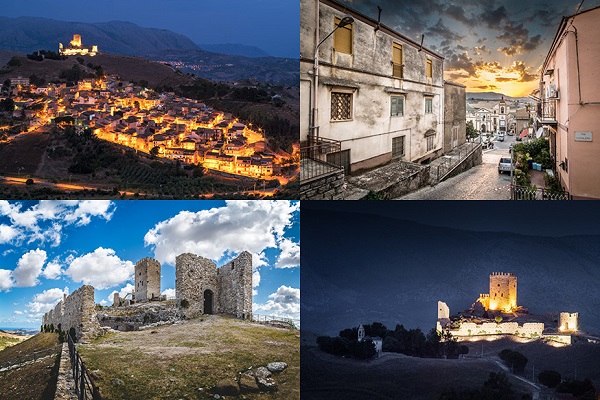
Cefalà Diana is a small inland hill village in the Province of Palermo, set about 540 metres above sea level in a rural landscape of slopes and agricultural land. The settlement lies below a rocky spur, with the surrounding heights and nearby protected countryside giving it a clear mountain-edge character rather than a coastal Sicilian identity.
Its name is thought to be linked to the head-like shape of that spur, possibly from the Greek *Kephalè*, meaning “head”, though the earliest origins remain uncertain. The area’s historical memory reaches through Arab and Norman phases, while the visible medieval identity of the village is tied to fortification and to its strategic position on routes between Palermo and the Val di Mazara.
The present centre began to form in 1684, when Nicolò Diana obtained the *licentia populandi* and promoted settlement around the older fortified site. Earlier in the 14th century, the fief had passed to the Chiaramonte family, adding another layer to its feudal identity. Today Cefalà Diana remains a compact, community-oriented borgo, distinctive for the way its rural setting, medieval memory and Diana-era foundation still define its character.
Patron Saint:
Saint Francis of Paola (San Francesco da Paola) – mid August
Nearest Airport:
Palermo (Falcone-Borsellino) – (64 km, 01:06)
Neighboring Cities:
Attractions in Cefalà Diana
Art and Architecture
Chiesa Madre di San Francesco di Paola: The eighteenth-century mother church has a bronze entrance known as the “Porta dei miracoli”, created by Sicilian sculptor Biagio Governali. Its twelve panels depict episodes from the Old and New Testaments alongside miracles attributed to San Francesco di Paola.
Santuario di Maria Addolorata: Standing opposite the castle, this sanctuary is associated with local devotion to the Madonna del Castello. It is a focal point of the religious celebrations held in May.
Monumento agli Emigranti: This monument in Piazza Umberto I is a work by Biagio Governali. It commemorates those who left Cefalà Diana in search of a better future.
Bagni di Cefalà Diana: At the foot of Pizzo Chiarastella, this historic thermal-bath building stands beside a hot spring. Its principal architectural feature is a large barrel-vaulted hall containing three bathing pools.
Castles
Castello di Cefalà Diana: The surviving fortress dates from between the second half of the thirteenth century and the early fourteenth century. A square tower with Ghibelline battlements and sections of the perimeter walls remain on the rocky outcrop, which overlooks the surrounding countryside.
Nature Sites
Riserva Naturale Orientata Bagni di Cefalà Diana e Chiarastella: This protected area extends just beyond the village, encompassing the landscape around Pizzo Chiarastella and the historic thermal baths. It brings together the natural setting of the hot spring and the area’s built heritage.
Things to Do in Cefalà Diana
Traditional Events
Festa di San Giuseppe: Local traditions include a procession with the saint’s statue to the Villa Comunale, where the customary vampa bonfire is lit. Religious celebrations are accompanied by blessed bread and a shared serving of the traditional minestra outside the church.
Settimana Santa: Holy Week begins on Palm Sunday with the blessing of olive branches at the Cappella dell’Ecce Homo and a procession to the Chiesa Madre, followed later by a live re-enactment of the Stations of the Cross. Good Friday observances include the ascent to Calvario and a procession of the Cristo Morto and the Addolorata through the village.
Festa di San Francesco di Paola: Celebrations on 2 April include a procession, solemn Mass and the distribution of biscotti di San Francesco. A larger celebration in honour of the saint takes place in August, combining religious and civic festivities.
Festa della Madonna del Castello: Held on 25 and 26 May, this celebration commemorates the reported apparition of the Addolorata at the castle. A torchlit procession carries her image to the sanctuary on the first evening, with its return to the Chiesa Madre the following day.
Festa dell’Immacolata: The celebration culminates on 8 December with a procession through the village. It includes a formal act of entrusting the community to the Madonna, performed by the mayor on behalf of residents.
Traditional Food
Local olive oil and agricultural produce: Olive growing and extra virgin olive oil production form part of Cefalà Diana’s agricultural traditions, alongside cereals and grapes. Other local products include wine, artisan cheeses and traditional cured meats.