
Caltavuturo is a small historic hill town in Sicily’s Madonie area, set within the Madonie Park and surrounded by rocky mountain landscapes. Its old centre has the compact character of a borgo, with narrow winding streets and a quiet atmosphere beneath the high ground that has long defined the settlement.
The town’s identity is closely tied to its Arab origins: its name is linked to *Kalat Abu Thur*, while an earlier fortified settlement known as Terravecchia stood in a strategic position above the Imera river valley. The present village later developed outside the old walls between the 16th and 17th centuries, when it was known as Terranova.
This layered past gives Caltavuturo a distinctive place in the Madonie, where Islamic, Byzantine and later Sicilian phases are part of the local memory. More than a simple mountain village, it is a town shaped by its position between rock, valley and old frontier landscapes.
Patron Saint:
Holy Mary of Soccorso (Madonna Del Soccorso) – 10 September
Nearest Airport:
Palermo (Falcone-Borsellino) – (108 km, 01:40)
Neighboring Cities:
Polizzi Generosa, Scillato, Sclafani Bagni, Castellana Sicula
Attractions in Caltavuturo
Archaeological Sites
Monte Riparato: This archaeological site preserves traces of an ancient settlement dated to the third and second centuries BC.
Art and Architecture
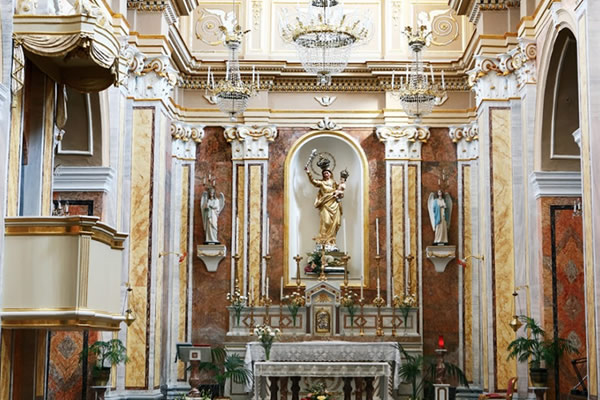
Chiesa Madre dei Santi Pietro e Paolo: Caltavuturo’s sixteenth-century mother church contains a marble Annunciation group from the Gagini school and an Adoration of the Magi attributed to the Flemish school. Its richly decorated organ came from the Church of San Bartolomeo.
Chiesa di Santa Maria del Gesù: Attached to the Franciscan convent, this church houses a seventeenth-century wooden crucifix by Fra Umile da Petralia. It also contains Pietro Novelli’s painting of Mary’s visit to Saint Elizabeth.
Chiesa di Santa Maria la Nuova: Also called the Badia, this single-nave church has eighteenth-century stucco decoration. Its artworks include sculpture from the Gagini school and a work by Filippo Quattrocchi.
Chiesa del Casale: This thirteenth-century church stands on the north-western slopes of Rocca di Sciara, outside the town centre.
Mannari: This former shepherds’ settlement beside Rocca di Sciara preserves stone sheepfolds, livestock enclosures and old hay shelters, illustrating the area’s pastoral heritage.
Castles
Castello di Terravecchia: Ruins of Caltavuturo’s former stronghold survive on the rocky heights above the present town. They form part of Terravecchia, the older settlement that preceded the development of the town below.
Nature Sites
Gole di Gazzara: Outside the built-up area, between Cozzo Ebreo and Cozzo Rosso, this limestone gorge was carved by the Caltavuturo stream. It lies within the Madonie Natural Park.
Things to Do in Caltavuturo
Traditional Events
Festa di San Calogero Eremita: Traditionally held on the first Sunday in July, this celebration includes a procession with the saint’s statue, the distribution of votive bread and entertainment.
Festa di Maria Santissima del Carmelo: This July religious celebration centres on the Chiesa di Santa Maria la Nuova, home to the confraternity dedicated to the Madonna del Carmelo.
Festival Internazionale del Folklore: Traditionally held in August and organised by Caltavuturo’s Gazzara folk group, the festival brings together international participants for folk singing, music and dance.
Festa di Maria Santissima del Soccorso: The traditional celebration on 10 September includes a procession through the town, accompanied by cultural and musical events.
Fungo Ferla Fest: This traditional November mushroom festival features tastings and folk performances.
Museums
Museo Civico di Caltavuturo: Housed in rooms overlooking the Franciscan convent’s cloister, the civic museum includes archaeological finds from the surrounding area. A geological section focuses on Rocca di Sciara.
Places to Visit Near Caltavuturo
Antiquarium di Himera: This museum in the territory of Termini Imerese houses the phiale aurea associated with Caltavuturo, a Hellenistic gold libation bowl dated between the late fourth and early third centuries BC.