
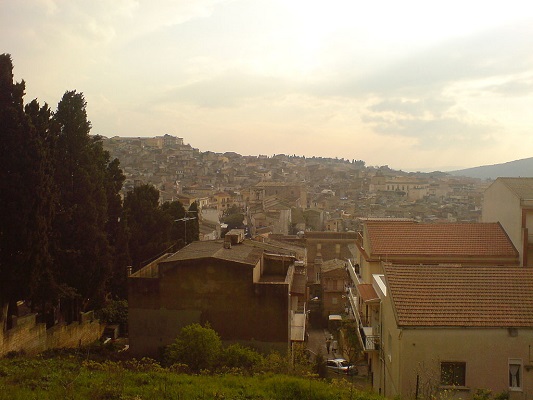
Grotte is a small agricultural town in the inland hills of the province of Agrigento, set among green slopes, vineyards and almond groves. Its name may derive from the Byzantine Greek “Krupte,” meaning “cave,” a reminder of the cavities and ancient traces that mark the surrounding area.
The town’s earliest identity is uncertain, but local tradition and historical sources connect the area with Herbessus or Erbesso, an ancient Sicel settlement later inhabited by Greeks. In later centuries Grotte became a feudal land under the Aragonese, before gaining municipal autonomy in 1812. Its history also carries a strong industrial memory: in the 19th century it was an important sulfur-mining centre, with thirteen mines active between 1830 and 1840.
Today Grotte retains the character of a rural Sicilian borgo, rooted in agriculture, local devotion and literary traditions, while its centre also carries a contemporary layer through urban art. What makes it distinctive is this combination of caves, cultivated hills, uncertain ancient origins and a mining past that still defines its local memory.
Patron Saint:
Saint Venera (Santa Venera) – 14 November
Nearest Airport:
Catania (Fontanarossa) – (124 km, 01:50)
Neighboring Cities:
Attractions in Grotte
Art and Architecture
Palazzo Comunale: Grotte’s town hall occupies the former Carmelite convent in Piazza Umberto. The convent dates from the late sixteenth century.
Chiesa della Madonna del Carmelo: Standing beside the former Carmelite convent, this church preserves an old wooden crucifix among its religious artworks.
Chiesa di Santa Venera: Grotte’s mother church has an interior decorated with chapels, statues and paintings. These include a depiction of Santa Venera painted in 1785 by Fra’ Felice da Sambuca.
Chiesa del Purgatorio: This church on Corso Garibaldi has an elliptical plan and retains a statue of San Vincenzo Ferreri, to whom it was originally dedicated. Beneath it is a large crypt formerly used for mummifying the dead.
Chiesa di San Rocco: Built as a rural chapel in 1575, this church stands on a hilltop. Its interior contains paintings and statues of saints.
Calvario: A staircase lined with centuries-old cypress trees leads to Grotte’s Calvary, reached from the town’s main road.
Torre del Palo: Also called Torre del Parrino, this fifteenth-century tower stands in the upper part of Grotte. Its octagonal plan and Gothic-style features distinguish it from the surrounding buildings.
Street Art in the Town Centre: Works of street art are scattered through the narrow streets of central Grotte, forming an outdoor collection rather than a single gallery.
Things to Do in Grotte
Traditional Events
Holy Week and Easter: Costumed participants enact episodes from Christ’s Passion and Crucifixion, accompanied by traditional laments. On Easter Sunday, the meeting of the risen Christ and the Madonna takes place in the square, with bells and firecrackers marking the occasion.
Premio Nino Martoglio: Held in July, this annual literary celebration recognises writers, poets, artists and figures distinguished in other fields. It was established by Aristotele Cuffaro to promote literature and culture.
Festa della Madonna delle Grazie: Celebrated on the third Sunday of September, the feast begins at the small church dedicated to the Madonna delle Grazie on the outskirts of Grotte. After Mass, the statue is carried through the centre to the Chiesa della Madonna del Carmelo, with music traditionally concluding the celebration.
Fiera del Bestiame: This annual livestock fair takes place in September and includes displays of sheep, reflecting the area’s livestock-farming tradition.
Festa di Santa Venera: The feast is celebrated on 14 November. Following a solemn Mass, a procession carries the statue of Santa Venera through the town centre.
Traditional Food
Impignolate: A local speciality, these savoury filled pastries contain minced pork and black olives.
Nero d’Avola: Nero d’Avola is produced in the Grotte area, where vineyards form part of the agricultural landscape alongside olive groves, almond orchards and cereal fields.
Places to Visit Near Grotte
Petra di Calathansuderj: Between Grotte and Comitini, this large rock formation contains excavated caves and interconnected passages. Rock-cut oven-shaped tombs and archaeological finds indicate prehistoric settlement here.
Bosco di Firrio: A few kilometres from Grotte, this woodland offers a setting for walks and outdoor picnics. Its equipped picnic area includes benches, tables and barbecues.
Practical Travel Information for Grotte
Getting There by Road: From Palermo, take the SS121 and SS189 towards Agrigento as far as the Aragona junction, then follow signs for Grotte.