
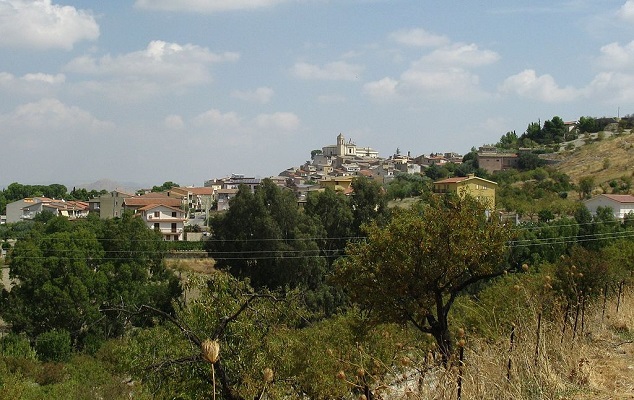
Comitini is a very small inland town in the Province of Agrigento, set on elevated ground at about 346 metres above sea level between Aragona and Grotte. Its territory is hilly and agricultural, and its name is linked in the sources to a nearby hill, recorded in one form as Cumatino. Compact and community-focused, it has the character of a historic Sicilian hill settlement whose identity is closely tied to land, faith and work.
The town’s roots reach back to antiquity: in Roman times it was known as Comiciana, along the ancient route between Agrigentum and Panormus. The modern settlement was formally founded in 1627 under the Bellacera family, before passing in 1673 to Michele Gravina, the first prince of the town. This feudal background still helps explain Comitini’s noble and religious imprint, while its strongest modern transformation came in the 19th century, when sulphur extraction made it a major mining centre.
Recognised in 2018 as the smallest city in Italy, Comitini stands out for the contrast between its tiny scale and its unusually dense memory: more than 70 sulphur mines, links to Luigi Pirandello and Salvatore Quasimodo, and a history that gives this small inland town a distinct place in Sicilian cultural life.
Patron Saint:
Saint James (San Giacomo) – 25 July
Nearest Airport:
Comiso (Pio La Torre) – (127 km, 02:01)
Neighboring Cities:
Attractions in Comitini
Archaeological Sites
Parco delle Zolfare: Comitini’s former sulphur-mining area preserves industrial remains that illustrate the extraction and processing of sulphur. These include horizontal galleries, vertical shafts, Gill furnaces and calcaroni, the structures used to heat sulphur-bearing rock.
Art and Architecture
Chiesa Madre di San Giacomo Maggiore: Standing in the highest part of the village, the mother church has a façade commissioned in 1725 by Princess Maria Antonia Gravina. Its interior contains Baroque stucco decoration, carved altars, angel sculptures and a statue of San Giacomo. A raised gallery, known as the littrinu, once allowed the baron to attend services directly from the neighbouring palace.
Chiesa dell’Immacolata: This seventeenth-century church was built on the remains of an earlier place of worship. It is a focal point of Comitini’s Holy Week rites, housing the religious figures carried through the village during the Good Friday processions.
Things to Do in Comitini
Traditional Events
Carnevale: Comitini’s Carnival celebrations centre on children’s entertainment and games, with masked dancing in Piazza Umberto for adults as well.
Festa di San Giuseppe: Held in March, this religious celebration includes the communal sharing of a traditional minestra in the main square after Mass.
Settimana Santa: Holy Week begins with the blessing of palms and olive branches, followed by a procession to the Chiesa Madre. On Good Friday, a figure of Christ carrying the cross leaves the Chiesa dell’Immacolata for the village’s Via Crucis, including an encounter with the Madonna Addolorata and a symbolic crucifixion at the Calvario. An evening procession accompanies the figure of the dead Christ and the Addolorata back to the church.
Sagra del Cacciatore: This July festival focuses on hunting traditions and local food, including game dishes. Its activities include falconry demonstrations, a hunting-themed fair and discussions.
Festa di San Giacomo: Celebrated on 25 July, the feast includes an evening procession carrying the statue of San Giacomo through the historic centre, accompanied by religious and civic representatives.
Christmas Celebrations: Local Christmas festivities include music from zampognari, traditional bagpipers, and communal tombola games in the square.
Museums
Museo delle Miniere e Antiquarium: Housed in the seventeenth-century Palazzo Bellacera, this museum explores the territory’s cultural and mining history. Photographs, minerals and documents record the sulphur industry that shaped Comitini’s economy.
Museo del Tricolore: Also housed in Palazzo Bellacera, this collection brings together historical documents and memorabilia relating to the origins of the Italian flag.
Traditional Food
Miscata Comitinese: This local savoury speciality is made with durum wheat flour and flavoured with olives, sausage, an onion preparation known as cipollata, and pecorino cheese.
Practical Travel Information for Comitini
Getting There by Car: From Palermo, take the SS121 and SS189 towards Agrigento, leave at the Comitini exit and continue on the SP60. From Agrigento, take the SS189 towards Palermo and use the Comitini exit.