
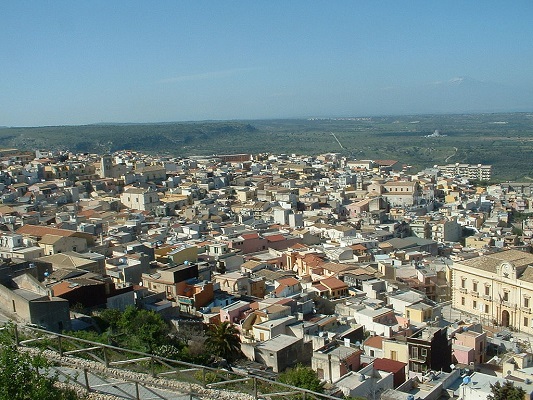
Melilli is a historic hill town in the Province of Syracuse, set about 310 metres above sea level on the eastern foothills of the Hyblaean Mountains. Known as the “Terrace of the Hyblaeans,” it looks out toward the Gulf of Augusta and the Ionian coast, combining a panoramic position with the compact character of an inland Sicilian town.
Its identity reaches far beyond its present streets. Human presence in the area is attested from the Bronze Age, while some scholars have linked the territory with ancient Hybla, a Greek settlement associated with honey. The name Melilli is said to derive from the Berber *Malilah* or *Malili*, meaning “busy path,” reflecting the Arab-Berber phase that helped shape the settlement after the 9th century.
Later mentioned in the Norman period, Melilli passed through Swabian and feudal history, including a long association with the Moncada family from the 15th century until the early 19th century. With its medieval urban structure, later Baroque layers and strong devotional memory, Melilli is distinctive for the way it gathers prehistoric traces, frontier histories and wide coastal views into one hilltop setting.
Patron Saint:
Saint Sebastian (San Sebastiano) – 4 May
Nearest Airport:
Catania (Fontanarossa) – (63 km, 00:51)
Neighboring Cities:
Augusta, Carlentini, Priolo Gargallo, Syracuse (Siracusa), Sortino

Attractions in Melilli
Archaeological Sites
Tomba Timognosa: This monumental prehistoric tomb lies in contrada Corte, between Melilli and Sortino. It forms part of the territory’s Bronze Age funerary heritage, associated with the Castelluccio culture.
Art and Architecture
Chiesa Madre di San Nicolò: Overlooking Piazza Duomo, Melilli’s mother church contains paintings and frescoes by the Catanese artist Olivio Sozzi. These works provide a focus for its eighteenth-century Sicilian decoration.
Basilica di San Sebastiano: The basilica houses the venerated statue of San Sebastiano and is closely associated with the local devotional tradition of the “nuri”.
Palazzo Municipale: Standing in Piazza Filippo Crescimanno, the town hall occupies a former Benedictine convent. Its construction used aggregate from the local “pirrere” and dressed stone from nearby quarries.
Chiesa di Sant’Antonio Abate: The church’s portal is decorated with bronze panels by the sculptor Domenico Girbino.
Chiesa di San Francesco: Attached to the Capuchin convent, this church contains a wooden altarpiece dated 1753 depicting three mysteries from the life of Jesus.
Chiesa del Carmine: White-stone altars distinguish the interior of this Melilli church.
Chiesa dello Spirito Santo: This church on Via Roma has a Baroque façade carved in limestone.
Pirrera Sant’Antonio: Also called the “Cava del Barocco”, this vast covered quarry lies at the foot of the cliff beneath Melilli. Its hand-cut galleries supplied limestone for the town’s historic buildings and churches.
Villasmundo: This village belongs to the municipality of Melilli and was founded in 1711 by Consalvo Asmundo Sessa. An inscription on the façade of the Chiesa di San Michele Arcangelo records its foundation.
Nature Sites
Riserva Naturale Integrale Complesso Speleologico Villasmundo-Alfio: Near Villasmundo, this nature reserve protects a karst cave system in the Iblei. Grotta Villasmundo lies along the Cugno di Rio stream and forms part of the protected complex.
Riserva Naturale Integrale Grotta Palombara: Near Città Giardino, a hamlet of Melilli, this reserve protects Grotta Palombara and its underground ecosystem. The cave extends for more than 800 metres; visits are restricted to experienced speleologists.
Things to Do in Melilli
Traditional Events
Carnevale Melillese: Melilli’s carnival tradition includes papier-mâché floats, masked groups, music and performances in the town’s squares.
Festa di San Giuseppe: Celebrated in March, the feast centres on a procession of the saint’s statue and a traditional auction of gifts donated by the faithful. The distribution of “minestra di San Giuseppe”, a soup prepared to a local traditional recipe, also forms part of the celebration.
Settimana Santa: The Good Friday evening procession brings the figures of Cristo Morto and Madonna Addolorata through the town. Easter Sunday traditions include the “Ncontru”, the meeting of the risen Christ and the Madonna, followed in the evening by “A Spartenza”, their symbolic separation in Piazza San Sebastiano.
Festa di San Sebastiano: Known locally as “A Festa i Maju”, this May celebration is associated with the devotional tradition of the “nuri” and the Basilica di San Sebastiano.
Sagra da Ginistredda: This August food festival in Villasmundo’s Piazza Risorgimento celebrates ginistredda, a fried speciality filled with ham and mozzarella. Food stalls feature local products alongside the festival’s namesake dish.
Sagra do Cudduruni a Miliddisa: Held in September, this Melilli festival celebrates the local focaccia, whose toppings include dried tomatoes, anchovies and onion. Live music accompanies the food celebrations.
Christmas Nativity Traditions: Melilli’s Christmas celebrations include monumental nativity displays and living nativity scenes associated with the Capuchin convent and the cork-oak woodland at Villasmundo.
Museums
Natural History Museum: The museum’s collection includes minerals, fossils and finds relating to the history of the local area.
Traditional Food
Cassateddi ca Ricotta: These ricotta pastries belong to Melilli’s Easter baking tradition.
Olio d’Oliva Monti Iblei DOP: Olive oil bearing the Monti Iblei protected designation of origin is among the agricultural products associated with Melilli.
Practical Travel Information for Melilli
Getting There by Car: From the Catania–Siracusa motorway, take the exit for Zona Industriale Melilli and follow the SP95 towards Melilli. The town is approximately 5 km from the motorway junction.