
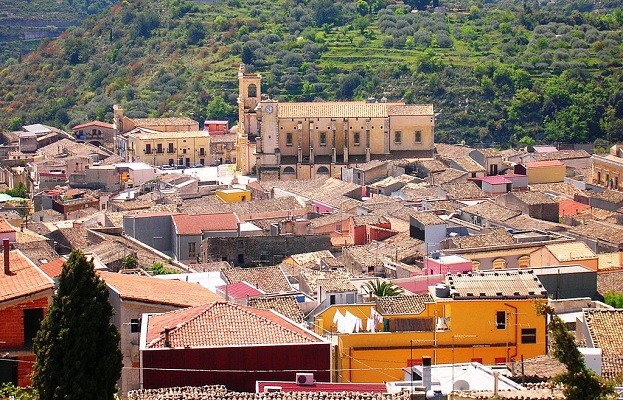
Ferla is a small Baroque town in the Siracusa area of south-eastern Sicily, set at 556 metres on the eastern side of the Hyblaean Mountains. At the foot of Monte Rigoria, its landscape is rural and limestone-edged, with olive groves, carob trees, almond trees and vineyards surrounding the settlement.
Its identity comes from the meeting of an older medieval core, remembered in the Castelverde quarter, and the Sicilian Baroque character that followed reconstruction after a major earthquake. The surrounding territory has much deeper roots, with prehistoric occupation and later Greek, Byzantine and Norman phases all forming part of its background.
Today Ferla remains closely tied to agricultural life and strong religious tradition, with a quiet historic centre shaped by stone streets, local memory and the mountain countryside around it. What makes it distinctive is this compact layering of Hyblaean landscape, medieval traces and post-earthquake Baroque rebuilding in a small inland Sicilian borgo.
Patron Saint:
Saint Sebastian (San Sebastiano) – 20 July
Nearest Airport:
Comiso (Pio La Torre) – (54 km, 01:07)
Neighboring Cities:

Attractions in Ferla
UNESCO Sites
Pantalica: Partly within Ferla’s territory, the UNESCO-listed archaeological site of Pantalica contains a necropolis of more than 5,000 rock-cut tombs in steep limestone cliffs. The surrounding canyons form part of the Riserva Naturale Orientata Pantalica, Valle dell’Anapo e Torrente Cava Grande.
Archaeological Sites
Area archeologica di San Martino–San Sisto–San Leonardo: This archaeological area contains rock-cut burial sites, including the Tomba di Dioniso and the Catacomba di Sant’Anna. A rock-cut church also preserves a fresco depicting Sant’Anna and San Pietro Apostolo.
Art and Architecture
Chiesa di Sant’Antonio Abate: Close to the Quattro Canti junction of Via Umberto and Corso Vittorio Emanuele, this church has a Baroque façade and a Greek-cross plan. Its interior contains stucco decoration, eighteenth-century wooden sculptures and paintings by Giuseppe Crestadoro.
Basilica di San Sebastiano: Ferla’s largest church houses a statue of San Sebastiano carved from orange wood and a painting depicting his martyrdom. The statue dates from 1530.
Chiesa Madre di San Giacomo: Rebuilt on the site of its predecessor after the 1693 earthquake, the mother church incorporates friezes and bas-reliefs recovered from other churches destroyed by the earthquake.
Chiesa di Santa Maria di Gesù: This church preserves a wooden crucifix attributed to Fra’ Umile da Petralia.
Chiesa di Santa Maria di Odigitria: Attached to the Capuchin convent, the church contains an eighteenth-century walnut-wood statue of the Madonna d’Odigitria on its high altar.
Quartiere di Castelverde: Ferla’s oldest quarter retains a medieval layout, with a network of narrow lanes, stone streets and caves. It offers a contrast to the town’s Baroque religious buildings.
Ex convento di Santa Caterina: The former Benedictine convent, used as Ferla’s town hall, is distinguished by its Liberty-style architecture.
Things to Do in Ferla
Traditional Events
Festa di Sant’Antonio Abate: Traditionally held on 17 January at the Chiesa di Sant’Antonio, this celebration includes Mass and the blessing of animals.
Festa di San Sebastiano: Ferla celebrates San Sebastiano on 20 January and again with a summer feast on 20 July. The January observances include the unveiling of the statue and the ritual known as the “Curruta”; the July celebration traditionally begins with 21 cannon shots at dawn and includes the statue’s emergence from the basilica amid showers of coloured paper.
Easter Celebrations: Ferla’s Holy Week traditions include the Good Friday procession of “’u Signuri a Cruci” with the Addolorata. On Easter Sunday, “U Scontru” represents the meeting between the risen Christ and the Madonna.
Festa della Madonna delle Grazie: Celebrated on 31 May, the feast includes a procession carrying the painting known locally as the “Matri Razia”.
Festa di San Giovanni Battista: The celebrations on 24 June include Masses and an evening procession carrying the saint’s statue through the Santa Sofia quarter.
Festa del Tartufo Nero: This July food festival celebrates Ferla’s black truffle, particularly the scorzone variety that grows in the Hyblaean woodlands. Tastings and entertainment accompany the celebration.
Festa del Santissimo Crocifisso: Held on the last Sunday of August, this religious feast centres on the crucifix preserved in the Chiesa di Santa Maria di Gesù.
Festa di Santa Sofia: The feast takes place on 10 September at the Chiesa di Santa Sofia, commemorating the saint’s martyrdom.
Festa di Santa Lucia: A local custom associated with this celebration is the blessing of cuccìa, which is distributed to the congregation after Mass.
Christmas Traditions: Ferla’s Christmas observances include nativity scenes in the churches, the traditional novena and the sharing of zeppole in the square.
Sagra re Pipicorni: This local food festival celebrates peppers associated with Ferla’s culinary traditions.
Traditional Food
Monti Iblei Olive Oil: Olive oil is one of Ferla’s characteristic agricultural products, with production associated with the Tonda Iblea olive variety.
Cuddureddi: These traditional local pastries have a filling of walnuts and honey.
Cassatedde: Ferla’s cassatedde are pastries filled with ricotta flavoured with cinnamon and egg yolk.
Local Cheeses: Ferla’s dairy products include provola, caciocavallo, tuma and ricotta.