
Monterosso Almo is a small hill village in the Monti Iblei, in the province of Ragusa, set at 691 metres above sea level and considered the highest municipality in the province. Its position on the Iblei mountain chain gives it a panoramic, inland character, surrounded by woods, valleys, streams and quieter natural landscapes suited to slow travel.
The village has very ancient roots, with evidence in its territory reaching back to prehistoric and early ancient periods, while its medieval identity is reflected in names such as Casal Lupino, Mons Rubens and Monte Ioalmo. In 1168 the settlement was donated to the Church of Syracuse by Goffredo, son of Count Ruggero of Ragusa, and in 1338 the name Mons Rubens was used in connection with Count Enrico Rosso.
Much of Monterosso Almo’s present form comes from the rebuilding that followed the destructive earthquake of 1693, when the town was reconstructed higher up with a Baroque urban layout. Quiet and outside Sicily’s busiest routes, it is distinctive for the way its mountain setting, deep historical layers and post-earthquake identity still define the village today.
Patron Saint:
Our Lady of Sorrows (Maria SS. Addolorata) – 1st Sunday in September
Nearest Airport:
Comiso (Pio La Torre) – (35 km, 00:40)
Neighboring Cities:
Attractions in Monterosso Almo
Archaeological Sites
Ipogeo di Calaforno: This prehistoric underground complex consists of 35 small chambers associated with burial use. It lies in the Calaforno area, among the archaeological sites surrounding Monterosso Almo.
Monte Casasia: The remains of an ancient settlement on Monte Casasia include numerous rock-cut tombs. Archaeological finds from the site form part of the collection at Monterosso Almo’s Museo Civico.
Art and Architecture
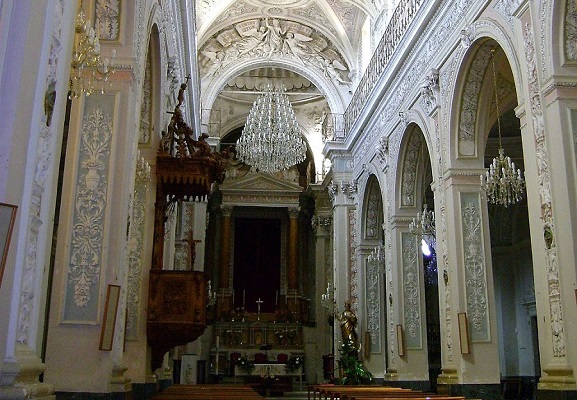
Chiesa Madre di Maria Santissima Assunta: Overlooking Piazza Sant’Antonio, the mother church has a neo-Gothic façade and preserves older features, including a floor in pietra pece, a dark local stone.
Chiesa di Sant’Antonio Abate: Facing the Chiesa Madre, this church is also known as the Santuario Maria Santissima Addolorata. Its Baroque façade and portal lead to an interior containing Renaissance artworks, including a sixteenth-century altarpiece depicting the Martyrdom of Saint Lawrence.
Chiesa di San Giovanni Battista: This Baroque church stands in Piazza San Giovanni. Its interior contains stucco decoration and religious artworks, including a statue of the sleeping Madonna.
Chiesa di Sant’Anna: The church’s vaulted ceiling is decorated with frescoes depicting episodes from the life of Saint Francis.
Nature Sites
Valle dell’Amerillo: Also called the Valle dei Mulini, this green valley contains disused watermills once powered by the River Amerillo. Old rural tracks, known as trazzere, and paths provide routes through the valley.
Parco demaniale di Canalazzo: This woodland area around Monterosso Almo contains old mills, wooden bridges and picnic areas. The Torrente Lavandaio, a tributary of the Amerillo, forms waterfalls and small pools in the surrounding landscape.
Things to Do in Monterosso Almo
Traditional Events
Festa di San Giuseppe: The celebration includes a procession carrying the saint’s statue through the town. Along the route, traditional altars prepared in different neighbourhoods are blessed.
Settimana Santa: Holy Week traditions include a living Via Crucis and processions on Holy Wednesday and Good Friday. On Easter Sunday, the ’Ncrinata marks the meeting of the risen Christ and the Virgin Mary, followed by a procession through the town.
Sagra dei Cavatieddi: Associated with the Festa degli Angeli on the third Sunday after Easter, this food festival celebrates small handmade pasta dumplings. Their preparation follows local recipes maintained by households in the Matrice quarter.
Festa di San Giovanni Battista: Celebrations dedicated to Saint John the Baptist take place on 24 June and again on the first Sunday of September.
Festa della Madonna Addolorata: The principal celebration, known locally as the Festa grande, takes place on the third Sunday of September.
Presepe vivente: During the Christmas festivities, the Matrice quarter provides the setting for a traditional living Nativity scene, staged among its narrow streets.
Museums
Museo Civico: Housed in Palazzo Cocuzza, the civic museum contains archaeological finds from Monte Casasia, connecting its collection with the ancient settlement outside the town.
Casa Museo Suor Rosa Roccuzzo: This house museum recounts the life of Rosa Roccuzzo, whose work supported vulnerable people in early twentieth-century Sicily. She founded the Congregazione delle Suore Orsoline della Sacra Famiglia.
Traditional Food
Scaccione: A rustic, wood-fired focaccia filled with seasonal local ingredients, scaccione is one of Monterosso Almo’s traditional foods.
Pecorino locale: Local sheep’s-milk cheese is among the products associated with the town’s livestock-farming tradition.
Scaurati: These traditional biscuits are briefly boiled before baking and flavoured with lemon juice and aniseed or fennel seeds.
Marsalati: These almond biscuits come in soft or crisp versions and may include candied fruit or whole almonds.