
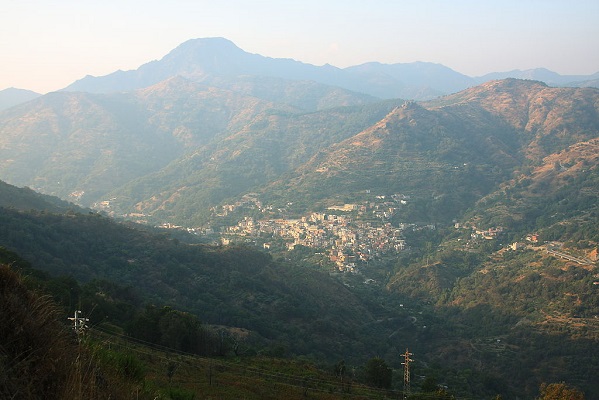
Antillo is a small village in the Valle d’Agrò, on the Ionian side of Sicily’s Peloritani Mountains. Set at around 480 metres above sea level on the left side of the Antillo stream, it sits between hill and mountain, beneath a steep rocky height and within a landscape that remains strongly rural.
Its origins are not described in a single clear way: some traditions point to very ancient settlement in the valley, while others emphasise a medieval foundation. The name Antillo may derive from the Latin *ante illos*, and for centuries the village was closely linked to the barony and territory of Savoca, becoming an autonomous municipality only in 1846.
This long dependence, together with its agricultural and pastoral life, gives Antillo a character rooted in mountain work, local devotion and community memory, including the experience of emigration. Its distinctiveness lies in this combination of Peloritani landscape, Valle d’Agrò identity and a small-village history that remained tied to Savoca for more than seven centuries.
Patron Saint:
Maria SS. della Provvidenza – 14 August
Nearest Airport:
Catania (Fontanarossa) – (108 km, 01:35)
Neighboring Cities:
Casalvecchio Siculo, Castroreale, Fondachelli Fantina, Francavilla di Sicilia, Graniti, Limina, Mongiuffi Melia, Motta Camastra, Roccafiorita, Rodì Milici

Attractions in Antillo
Art and Architecture
Chiesa Madre di Santa Maria della Provvidenza: Overlooking the main square, Antillo’s mother church was rebuilt in 1938 on the site of an earlier church. Inside is a venerated image of the Madonna della Provvidenza.
Fontana Acqua Vena: This fountain dates from 1894 and has a distinctive sculpted face, or mascherone, through which the water flows. Local tradition identifies the face as that of a mayor of the period.
Campana della Pace: Standing on the summit of Pizzo Monaco, the Peace Bell commemorates those missing in all wars. Its hilltop setting overlooks the surrounding valley.
Nature Sites
Rocca Castello: Also called Pizzo Castello, this steep, rocky height rises to 765 metres above the Valle d’Agrò. It retains traces of rock-cut fortifications, with views across a landscape of woodland and streams.
Pizzo di Vernà: This Peloritani summit is shared by the territories of Antillo, Casalvecchio Siculo and Fondachelli Fantina. Views from the top extend towards Etna, the Ionian and Tyrrhenian coasts, and Rocca di Salvatesta.
Valle dei Platani: This valley in Antillo’s countryside contains the Castagna picnic area and a small spring. It offers a woodland setting for an outdoor stop.
Grotte della Ranciara: These natural caves lie close to Antillo. The complex was formed by the erosive action of the River Agrò on the rock.
Things to Do in Antillo
Traditional Events
Festa di Sant’Antonio: The feast is celebrated on 13 June, with a second celebration on 21 August. The August observance includes an evening procession through the village.
Festa della Madonna della Provvidenza: Held on 22 August, this celebration combines religious observances with community festivities. A procession sets out in the late afternoon, accompanied by the rosary and Marian hymns.
Sagra della Castagna: Antillo’s October chestnut festival celebrates the autumn harvest, with chestnuts and other local produce at its centre.
Sagra del Maiale e del Cinghiale: This December food festival focuses on pork, wild boar and products made from them, reflecting local meat-processing traditions.
Museums
Museo Agro-Pastorale: Established in 1980, this museum brings together objects and tools associated with Antillo’s farming and pastoral traditions. Its collection documents rural work and everyday customs.
Traditional Food
Ricotta and Local Cheeses: Cattle, sheep and goat farming underpin Antillo’s dairy traditions. Local products include fresh ricotta alongside soft and matured cheeses.
Artisanal Salumi: Sausage and salami feature among Antillo’s traditional foods and are associated with local festive tables.
Maccheroni and Wood-Fired Bread: Maccheroni and rustic bread baked in wood-fired ovens are among the foods associated with Antillo’s rural culinary tradition.