
Gibellina is one of Sicily’s most unusual towns: a new settlement in the Belìce area, built in contrada Salinella on the territory of Salemi after the 1968 earthquake destroyed the old medieval centre. The abandoned original town is remembered as Gibellina Vecchia, while Gibellina Nuova was conceived at a distance from it, with wide avenues, broad open spaces and a distinctive butterfly-shaped plan.
Its identity is inseparable from reconstruction. The name Gibellina is said to derive from the Arabic *gebel*, meaning “height”, a reminder of the older settlement’s position near Monte Roccatonda and of a history that reached back to the medieval village linked to Manfredi Chiaromonte in the 14th century. After the earthquake, mayor Ludovico Corrao promoted a new civic idea: rebuilding not only through housing, but through contemporary art and architecture.
Today Gibellina is defined by that ambitious post-earthquake vision, where rural Sicilian landscapes and modern urban design meet in a town shaped as a symbol of rupture, memory and cultural renewal.
Patron Saint:
St. Roch (San Rocco) – 16 August
Nearest Airport:
Trapani (Birgi) – (54 km, 00:58)
Neighboring Cities:
Calatafimi Segesta, Monreale, Poggioreale, Salaparuta, Salemi, Santa Ninfa

Attractions in Gibellina
Art and Architecture
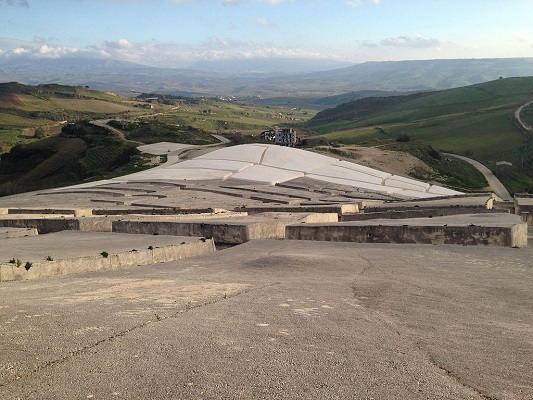
Cretto di Burri: Alberto Burri’s work covers the ruins of Gibellina Vecchia with white concrete, commemorating the town destroyed by the 1968 Belìce earthquake. The fissures follow the street layout of the former settlement, preserving its outline within the artwork.
Stella d’Ingresso al Belìce: Pietro Consagra’s 24-metre-high star marks the entrance to Gibellina Nuova. Also known as the Porta del Belìce, this monumental sculpture was conceived as a symbol of rebirth.
Chiesa Madre: Designed by Ludovico Quaroni, Gibellina’s modern mother church is distinguished by its large white concrete sphere. Its unconventional form makes it a recognisable element of the rebuilt town’s architecture.
Piazza XV Gennaio 1968: Named after the date of the earthquake, this square brings together architecture and public art. Its principal features include Alessandro Mendini’s Torre Civica and the portico designed by Vittorio Gregotti and Giuseppe Samonà.
Montagna di Sale: Mimmo Paladino’s sculptural installation stands in the garden of the Fondazione Orestiadi at Casa Di Stefano. The work originated as a theatrical stage design, linking Gibellina’s public art with its performance traditions.
Things to Do in Gibellina
Traditional Events
Ciocco Fest nel Belìce: This February celebration centres on chocolate, with tastings, workshops and entertainment.
Festa di San Giuseppe: Celebrated in March, the feast features votive altars decorated with traditional foods. A meal offered to li virgineddi forms part of the local observance.
Settimana Santa: Gibellina’s Holy Week rites culminate on Easter Sunday with the meeting of the figures of Jesus and Mary, followed by a solemn procession towards the Chiesa Madre.
Festa Ranni: Held in May in honour of the Santissimo Crocifisso, this celebration includes the traditional parade of the prisenti and a solemn procession, alongside cultural and folk events.
Scirocco Wine Fest: This June festival is dedicated to wine production from countries around the Mediterranean.
Orestiadi: Associated with July and August, this international arts festival brings together theatre, music, opera and experimental musical and visual work.
Festa di San Rocco: The celebration on 16 August includes a procession carrying the statue of San Rocco.
Sagra del Melone Giallo: This August food festival celebrates the locally grown yellow melon, distinguished by its wrinkled rind and sweet flesh. Tastings and entertainment form part of the festivities.
Museums
Museo Civico d’Arte Contemporanea: The civic contemporary art museum holds paintings donated by artists including Carla Accardi, Beniamino Joppolo, Toti Scialoja, Afro Basaldella, Renato Guttuso and Fausto Pirandello.
Museo delle Trame Mediterranee: Housed at Casa Di Stefano within the Fondazione Orestiadi, the museum brings together art and archaeological objects from Sicily, North Africa and the Near East. Its collection explores connections across Mediterranean cultures.
Traditional Food
’Nfigghiulata: This local bread speciality is a focaccia filled with sausage, potatoes and onion.
Muffuletta: Gibellina’s muffuletta is a bread roll flavoured with wild fennel, traditionally eaten freshly baked and dressed with extra virgin olive oil.
Practical Travel Information for Gibellina
Getting There by Car: From Palermo, take the A29 Palermo–Mazara del Vallo motorway, leave at the Salemi junction and follow signs for Gibellina.